
4 success factors for the introduction of digital Patient Education in everyday clinical practice
Digitalization in hospital operations is no longer a nice-to-have. It determines efficiency, patient throughput and the ability of a facility to cope with increasing case numbers with limited resources. However, the user-centered development of digital solutions has long been neglected in the healthcare sector. At the same time, the experienced provider medudoc shows very clearly what modern Patient Education can look like today: digital, individualized and consistently aligned with real clinical processes.
Many processes in hospitals are still paper-based, even though medical treatment itself takes place at the highest technological level. This disconnect between digital high-end in the operating room and analog routine in everyday ward life slows down specialists and takes up capacity that is actually needed for patient care.
The administrative burden has increased continuously in recent years. While only a small proportion of hospital doctors spent four hours or more a day on documentation and organizational activities in 2013, this was already the case for more than a third in 2019 (see Marburger Bund Monitor 2019). Many doctors want to pursue their therapeutic task and not primarily manage forms. This is precisely where modern digital solutions could provide crucial support.
Patient Education is a particularly clear example. Complex in content, legally binding and yet hardly modernized in many hospitals for decades. Paper sheets with technical terms continue to characterize the standard, although it has long been well documented that audiovisual information increases understanding and has positive effects on compliance and post-operative outcomes.
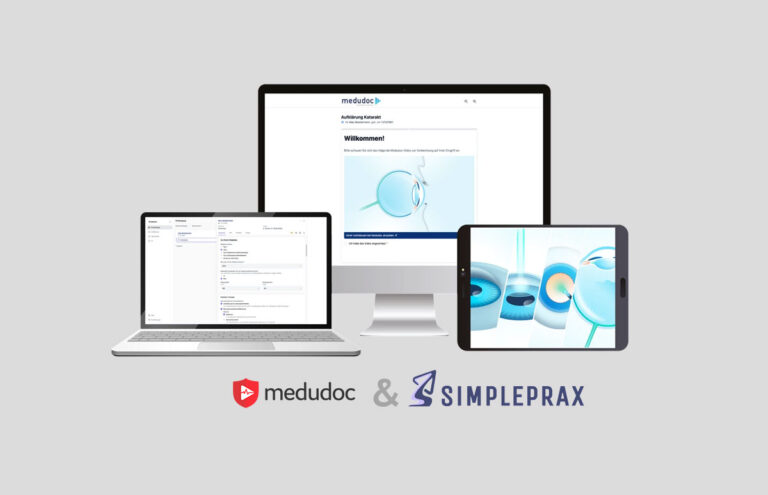
Together with clinics, medudoc has developed a platform on which doctors can create individualized educational videos. The content is medically sound, medicolegally compliant, easy to understand and tailored to the respective procedures. The solution is already in use in Germany and Switzerland and shows that digitalization is effective in everyday clinical practice when it creates real added value.
Success factor 1: Digital solutions must be developed together with clinical specialists
If digital applications are to be used across departments, they must be coordinated with different doctors from the outset. Development at medudoc therefore took place in close cooperation with surgical, internal medicine and other specialist departments. The feedback from everyday clinical practice played a key role in ensuring that the platform is intuitive to use and reflects the actual requirements of healthcare. This early involvement ensures that new digital workflows are not perceived as an additional burden, but as genuine support.
Success factor 2: Iterative work instead of rigid product development
Many clinics are used to being presented with ready-made systems. However, this approach is too slow for digital product development. Prototypes and usability tests are crucial in order to visualize real usage scenarios. At medudoc, these test phases led to the initial concepts being revised several times and ultimately completely redesigned. This process resulted in a solution that does not function theoretically, but can be used reliably in the hectic day-to-day running of a clinic.
Success factor 3: Technology must be flexibly adapted to hospital processes
Clinics differ greatly in terms of processes, structures and responsibilities. Successful digitalization therefore requires systems that can be flexibly adapted. The medudoc platform allows content, workflows and integrations to be configured individually. This does not replace existing processes, but optimizes them in a targeted manner. This ensures rapid embedding in different specialist areas and smooth use without additional effort.

Success factor 4: Digital solutions only work if they complement existing processes holistically
Digital transformation only becomes effective when it is considered an integral part of clinical processes. Video-based Patient Education is shifted to the exact point in the workflow where the need for information is highest. Patients receive their video before their consultation with the doctor and are prepared for the face-to-face consultation. This reduces the number of queries, shortens consultation times and also reduces the burden on documentation. Clinics report time savings of up to 50 percent in the information process and a significant reduction in everyday medical workload. The effect is measurable: more capacity, higher patient throughput and a noticeable increase in the quality of information.
medudoc is continuously working with clinics to further expand the content and provide sustainable support for the digitalization of Patient Education. Practical experience shows that digital solutions are successful when they work intuitively, create real efficiency gains and focus on patient care.