
6 factors that influence patient understanding during preoperative information
Preoperative medical information is a crucial step in the treatment process. It ensures that patients can make an informed decision about upcoming procedures. To do this, however, the patient must have understood the information provided in as much detail as possible.
Unfortunately, this is not always the case. In the following, we show which factors affect the patient’s understanding of the upcoming procedure and how this can be avoided by using medudoc’s modern information solution.
Factors for patient understanding
1. complexity of medical information
Medical information is often very detailed and contains complex technical terms that are difficult for the layperson to understand. The use of complicated medical terminology significantly impairs patients’ quality of understanding. They feel overwhelmed and do not fully understand the consequences of their decision.
2. type of information presentation
The way in which information is communicated is crucial to patients’ understanding of the upcoming procedure. Visual aids such as diagrams, videos, interactive explanations and clear language contribute significantly to better understanding.
3. educational level and cognitive abilities
Patients with a higher level of education and more developed cognitive skills are generally better able to understand complex medical information. In contrast, patients with a lower level of education may find it more difficult to process such information. Therefore, a customized communication strategy is crucial to ensure that all patients receive the information relevant to them in an understandable way.
4. anxiety and stress before the operation
The emotional state of patients plays a significant role in their ability to absorb educational information. Anxiety and stress can significantly impair the understanding and memorization of the content conveyed, which increases the risk of misunderstandings.
5. time pressure in the medical practice
In medical practice, there is often not enough time to provide comprehensive and understandable information. Time pressure leads to information being shortened or communicated less clearly. As a result, patients do not have enough opportunity to ask questions or process the information at their own pace, which makes it more difficult to understand.
6. language barriers
Language barriers are another key factor that can significantly affect patient understanding. Patients whose native language is not the same as the doctor’s often find it difficult to fully understand medical information, which can lead to misunderstandings.
Digital solutions as the key to improving Patient Education
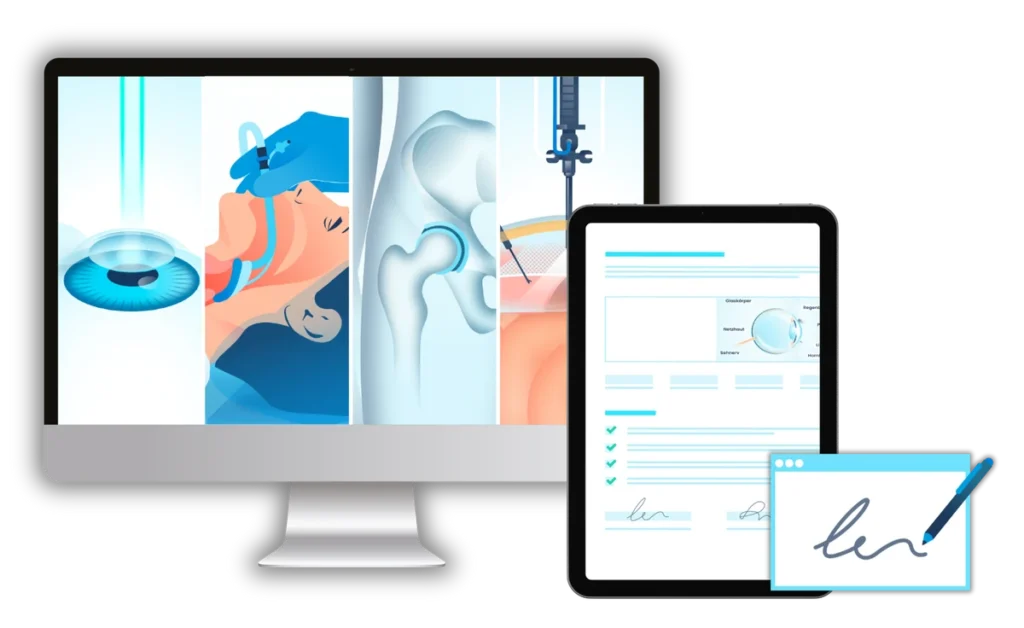
A promising solution to the previously described challenges of informed decision-making before a procedure is offered by medudoc’s innovative Patient Education. medudoc provides a video-based, customizable platform that presents medical information in a layman-understandable and visual form. Patients can understand the content in their own language and at their own pace, enabling them to make informed decisions.
A particular advantage of medudoc is the modular structure of the platform, which allows specific information to be added individually for each procedure. For example, when providing information on anesthesia procedures, relevant accompanying measures can be easily integrated, which significantly improves risk disclosure. All content is created in accordance with the guidelines of the professional associations and independently checked by practicing doctors to ensure the highest quality and safety.
The use of visual aids such as videos ensures that even complex medical issues are presented in an understandable way. This is particularly valuable for patients suffering from stress or anxiety, as they have the opportunity to view the information several times and thus deepen their understanding.
Conclusion: Improving the quality of understanding through modern approaches
Patients’ understanding of preoperative information is influenced by many factors, including the complexity of the information, the type of communication, emotional states and language barriers. Digital Patient Education, as offered by medudoc, provides a modern solution to overcome these challenges. Customizable, video-based education in simple language and visual support significantly increases comprehensibility, which contributes to a well-founded and informed decision by patients.
A better understanding of the information provided not only leads to greater patient safety and trust, but also reduces the risk of legal disputes and improves the overall quality of medical care.
Sources
- Braddock, C. H., Edwards, K. A., Hasenberg, N. M., Laidley, T. L., & Levinson, W. (1999). Informed decision making in outpatient practice: time to get back to basics. JAMA, 282(24), 2313-2320.
- Houts, P. S., Doak, C. C., Doak, L. G., & Loscalzo, M. J. (2006). The role of pictures in improving health communication: A review of research on attention, comprehension, recall, and adherence. Patient Education and Counseling, 61(2), 173-190.
- Julliard, K., Vivar, J., Delgado, C., Cruz, E., & Kabak, J. (2008). What Latina patients don’t tell their doctors: a qualitative study. Annals of Family Medicine, 6(6), 543-549.
- Ley, P. (1988). Communicating with patients: Improving communication, satisfaction and compliance. New York, NY: Croom Helm.
- Pizzi, L. T., Chelly, J. E., Marlin, V. D., & Choe, I. (2012). Factors related to patient understanding of preoperative analgesic plans. Patient Education and Counseling, 86(2), 237-242.
The author

Prof. Dr. med. Lothar Schweigerer
Lothar Schweigerer is a pediatrician, oncologist and cancer researcher. He was Chair of Pediatrics at the University Medical Center Göttingen and Chief Physician of the Clinics for Pediatric and Adolescent Medicine at Helios Klinikum Berlin-Buch and Klinikum Frankfurt (Oder).