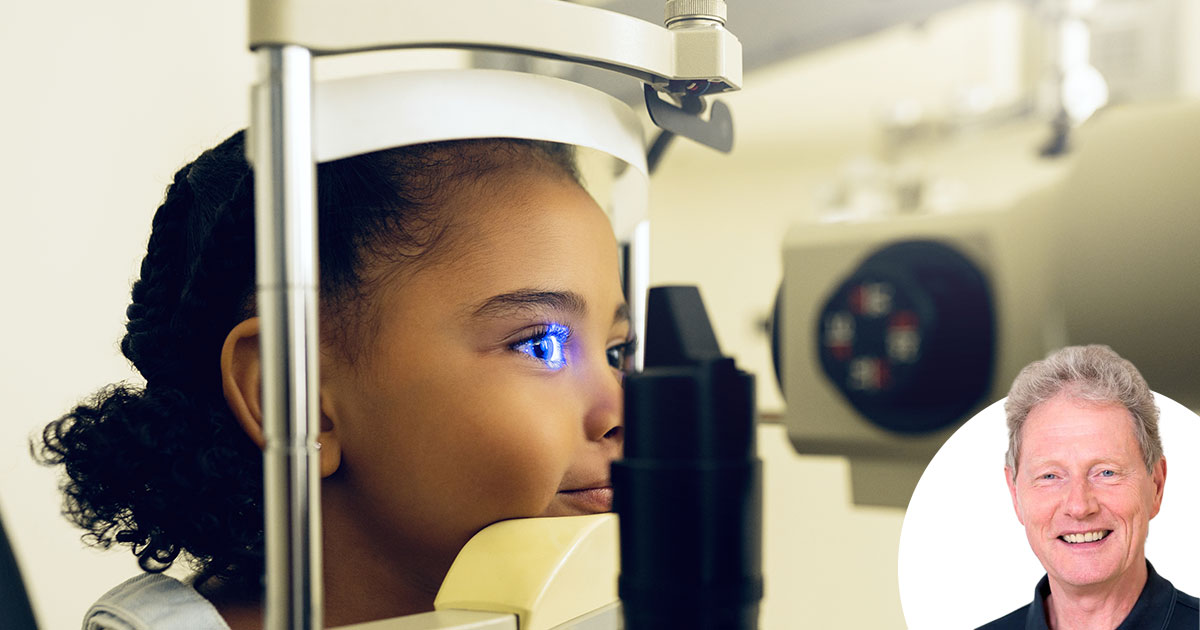
Digital Concepts of Patient Education in Ophthalmology
Digitalization is also advancing rapidly in ophthalmology. However, Patient Education, as it is still practiced in many places today, has considerable deficits. Prof. Dr. med. Lothar Schweigerer explains what these are, how they can be remedied and what future developments lie ahead. He is an emeritus professor of pediatrics and works as a senior medical officer at medudoc, a medical start-up in the field of Patient Education.
Interview with Professor Schweigerer
Professor Schweigerer, what are the fundamental challenges facing ophthalmology?
Schweigerer: The challenges in ophthalmology are basically very similar to those in other clinical disciplines: The DRG system causes scarce financial resources, the feminization of the medical profession and the increasing desire for a “work-life” balance cause scarce personnel resources. The aim must therefore be to use existing medical staff as economically as possible by freeing them from redundant tasks that are not related to doctors. For example, the staff providing information to patients before planned interventions must have several identical explanatory discussions with patients every day. Tailor-made hardware and software could reduce the time required.
How important is Patient Education and what is the current legal situation?
Schweigerer: In principle, every medical intervention is a bodily injury with corresponding legal consequences. The latter can only be prevented by obtaining the patient’s explicit verbal and written consent. In the past, the rules on informed consent were determined solely by case law and could not be read explicitly by either patients or doctors, but in 2013, informed consent was enshrined in the German Civil Code for the first time in the form of the Patients’ Rights Act.
It is essential for the staff providing information that the burden of proof in the event of complications and demonstrably incomplete information lies with the person providing the information. Comprehensive, lay-understandable Patient Education and its clear documentation are therefore essential.
What are the disadvantages of analog Patient Education?
Schweigerer: Digitalization is now also affecting the medical sector. Many clinics and practices already have digital patient documentation systems, but in many cases information is still provided in analog form using paper forms. These analogue solutions are not compatible with the already digitized patient file, they are time-consuming, redundant and usually difficult for patients to understand. Some providers have prepared the paper forms as digital (pfd) forms. A wide range of indications and a variety of languages are advantageous. Some manufacturers offer the option of handwritten and/or photographic entries in the form and the digital recording of patient history and signature. The disadvantages of all these solutions are the limited ability for individualization, low patient comprehensibility, high time expenditure and – depending on the experience of the person providing the information – a variable quality of information.
What are the advantages of digital education?
Schweigerer: In principle, fully digital Patient Education solutions offer the following advantages: Reduction of the time required by the educators, consistent quality of education and comprehensibility for patients, seamless integration into the digital patient file and, finally, legal certainty. The patient education software from medical start-up medudoc offers all of these advantages.
How does education work with the medudoc solution?
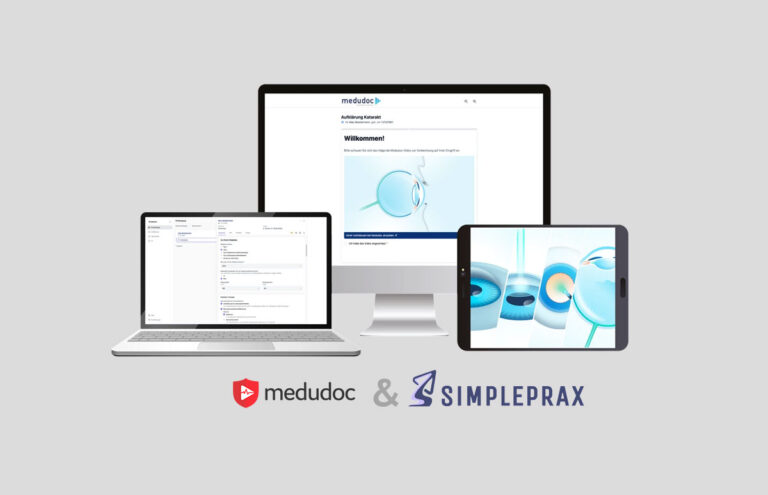
Schweigerer: After the medical staff providing information has given the indication for the procedure, it takes just a few clicks on the screen to put together an overall video tailored to the patient, their procedure and their pre-existing conditions from an extensive library of small video snippets in less than a minute. Each video has an individual QR code or internet link, which the patient can use to watch their own video at home or in the clinic or practice as often as they wish.
Which ophthalmologic indications are available?
Schweigerer: medudoc offers patient education materials for all common ophthalmic procedures, including blepharoplasty, intravitreal surgical drug injection (IVOM), capsulotomy, cataract surgery, laser-assisted in situ keratomileusis (LASIK), photorefractive keratectomy (PRK), refractive lenticule extraction (ReLEx) and iridotomy.
What advantages does the medudoc solution offer in the clinic or practice workflow?
Schweigerer: medudoc was initiated by practicing surgeons based on their personal experience. They recognized that the analog-based Patient Education systems available to date have four main disadvantages: they are 1. time-consuming, 2. redundant, 3. variable in quality and 4. incompatible with digital patient information systems. Accordingly, with the medudoc solution, medical staff need less than a minute on average to produce a customized information video. This eliminates many questions and shortens the pre-operative personal consultation. The information is standardized, the quality is consistent and largely independent of the experience of the person providing the information. The software is web-based and offers interfaces for all patient information systems.
Can older people use the product?
Schweigerer: Nowadays, most older people also have their own smartphone. They can therefore watch the information video, provide anamnestic information and sign digitally. If they have limited intellectual understanding, the procedure is the same as for conventional information, where patients are supported by the relatives present. If no smartphone is available, all information can also be printed out on paper and given to the patient.
Are patients’ rights protected?
Schweigerer: Yes. The video given to the patient together with its “kit” snippets are numbered, anonymized and stored on a central server outside the clinic / practice. They can be regenerated for at least 10 years, as required by law.
Is the clarification legally secure?
Schweigerer: With the medudoc solution, all video content is documented and stored in digital and / or analog form. The patient signs (digitally) that they have understood all the content of the video and the verbal consultation. The signature is also stored digitally. The procedure is therefore legally compliant.

What hardware is required?
Schweigerer: As already mentioned, the medudoc patient education software is web-based and therefore platform-agnostic. There is no need to purchase separate hardware or software.
How do you see the future of Patient Education?
Schweigerer: In many places, digital patient records are already part of everyday patient care. However, Patient Education is often not yet digitized or integrated. Fully digitized, video-animated, customizable solutions that save time (such as the one offered by medudoc) will prevail in the future.