Digital Patient Education: How modern medical practices design “Informed Consent” in a legally compliant and efficient manner
Digitalization is revolutionizing everyday practice – especially in Patient Education. The term Informed Consent no longer just stands for signing a patient information sheet, but for a transparent, comprehensible and legally compliant process that combines medical quality and patient trust.
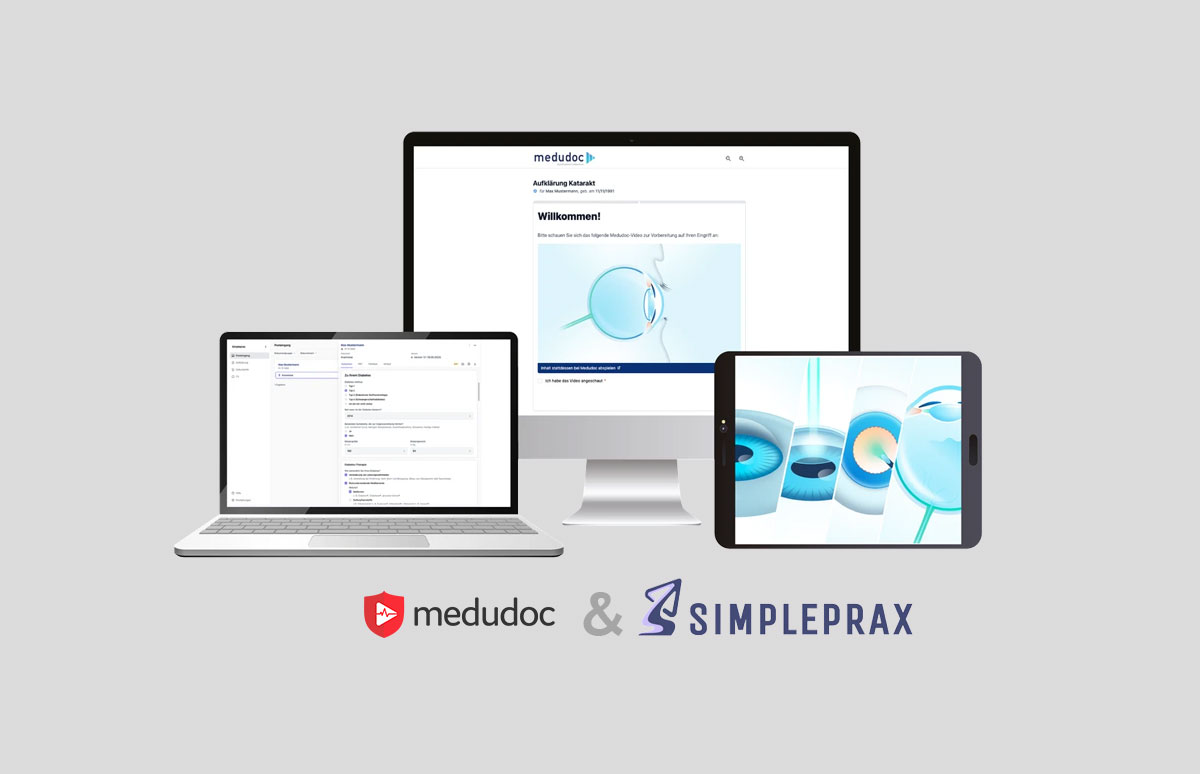
With digital solutions such as the interaction between medudoc and Simpleprax, this claim becomes reality: an automated, end-to-end process from the medical history to the informed consent to the digital declaration of consent – fully GDPR-compliant and without paper chaos.
What does “informed consent” mean today?
Informed consent describes the patient’s informed consent following comprehensive explanation by the doctor. It is legally binding and forms the basis of every medical intervention. In Austria, it is enshrined in § consenting patients’ rights and in the Medical Act.
However, traditional paper forms, illegible signatures or missing documentation not only jeopardize legal protection, but also patient safety. A digital Patient Education ensures that information, understanding and consent take place in a verifiable process – comprehensible, complete and legally documented.
The digital path: from anamnesis to clarification
The cooperation between medudoc and Simpleprax provides a practical example of the implementation of modern information processes:
- Digital anamnesis: Patients fill out the anamnesis form online before the appointment – conveniently via link, QR code or practice tablet.
- Data integration: The data flows automatically into the practice software (PVS), without manual entry or piles of paper.
- Personalized information: medudoc creates individually adapted information videos for planned procedures. The patient can obtain information, ask questions and repeat content – making the information more comprehensible and sustainable.
- Digital Informed Consent: The declaration of consent is digitally signed directly in the system in a legally secure manner.
- Automated documentation: All data, videos, signatures and forms are archived centrally – GDPR-compliant, tamper-proof and retrievable at any time.
This interaction eliminates media discontinuities and creates a continuous digital process chain from recording to documentation.

Why digital Patient Education is the future
1. legal certainty and traceability
Every clarification is digitally documented, versioned and stored in an audit-proof manner. Changes, signatures and time stamps make the entire process legally robust – a decisive advantage in the event of disputes.
2. increase in efficiency
According to medudoc, practices save an average of over 65 hours per month by eliminating paper processes, queries and manual entries.
3. cost savings
Automated processing significantly reduces material and personnel costs. In a typical specialist practice, the potential savings can amount to over 6,000 euros per month.
4. patient satisfaction
Patients understand their treatment better because they can consume content in a visually and linguistically adapted way. This increases trust and improves the doctor-patient relationship.
5. image gain
Digital education demonstrates innovative strength and signals modern, patient-oriented practice management – a strong differentiator in the healthcare market.
Legal requirements for digital Patient Education
Certain requirements must be met for the digital process to be legally compliant:
- Voluntary and informed consent: The patient must receive and understand all relevant information and consent without pressure.
- Proof of information: The doctor must be able to prove that the information was complete in terms of content – digital protocols and videos provide evidence here.
- Data protection: All patient data must be processed in accordance with the GDPR. Systems such as Simpleprax use encrypted transmission and secure server locations within the EU.
- Electronic signature: Digital signatures must meet the requirements of the eIDAS Regulation in order to be legally valid.
- Integrity of the data: It must not be possible to change documents retrospectively; every change must be recorded in a traceable manner.
Digital informed consent is only equivalent to paper-based consent if these points are complied with.
Best practice: Digitization in practice
An example from the field of ophthalmology illustrates the potential: Dr. Arash Zarkesh was looking for a flexible solution to provide his patients with digital information. With medudoc, he was able to use personalized videos and digital consent forms – the result: noticeable relief in everyday practice, satisfied patients and error-free documentation.
“Many software solutions cannot be sufficiently adapted to the individual processes of a practice. I wanted a flexible solution for my work that I could use in a variety of ways. With medudoc, I found a provider that exceeded my expectations.” – Dr. med. Arash Zarkesh
The connection to Simpleprax also enabled automated filing and integration into the practice software. The entire process – from the first data entry to the archived clarification – is now completely digital and legally compliant.
Implementation: How to make the switch
Check system integration: Interfaces to the existing PVS are crucial in order to avoid duplicate entries.
Train the team: Medical assistants should be trained in the use of tablets, QR codes and digital forms.
Adapt patient communication: Not every patient is digitally savvy – a hybrid offering (digital + paper) can ease transition phases.
Update data protection concept: New processes must be integrated into the existing data protection management system.
Start pilot phase: First test with selected treatments before converting the entire practice.
Conclusion: Digital education as the key to quality and legal certainty
The future of Patient Education is digital, personalized and legally compliant. Systems such as medudoc and Simpleprax create the framework for this: They combine medical responsibility with modern technology.
This does not weaken informed consent, but strengthens it – through transparency, traceability and verifiability.This means more trustfor patients,less risk and more efficiencyfor doctors.
Those who provide information digitally today not only secure their legal position, but also position themselves as pioneers of modern, patient-centered medicine.