
Legally compliant Patient Education 2025: Why comprehensive information is indispensable today – insights from current case law and digital innovation
Patient Education is a “non-negotiable” in both Austrian and German law. It is a core component of every treatment contract (Austria: ABGB in conjunction with the Patients’ Rights Act; Germany: Sections 630a-630e BGB). In operational terms, this means that without valid, complete, individual and legally compliant information, there is a massive liability risk for doctors – with clear impact zones on liability, documentation, litigation risk and the reputation of the institution.
Current court decisions clearly show that the requirements are increasing, as are the expectations of the courts. At the same time, it can be observed that traditional information processes are often under pressure in clinical reality – lack of time, language barriers, heterogeneous patient groups, varying documentation quality.
This is precisely where digital solutions such as medudoc come in: They professionalize the investigation process, create uniform quality standards and significantly reduce the risk of forensic gaps.
Why comprehensive information is mandatory today
Courts no longer just examine whether information was provided – but how deeply, how individually and how documented. The “standard of care” has clearly shifted towards full communication of risks and alternatives. The following drivers can be identified from our research analysis:
- Individualization obligation
Information must be patient-specific – health status, age, previous illnesses, special risks, psychological stress. Standard forms without individual reference are increasingly considered inadequate. - Transparency about rare risks
Rare complications must also be explained if they are serious or may be individually relevant. - Information about alternatives
The patient must be put in a position to make a real decision between treatment options – including conservative alternatives. - Comprehensibility as a compliance factor
The information must be comprehensible to laypersons – a recurring problem in lawsuits due to information errors.
Current proceedings from case law
The following cases decided in Germany show model situations in which gaps in information have led to liability. The findings are transferable to Austria, as the principles (right to self-determination, documentation obligation, risk disclosure) are congruent.
Case 1: OLG Dresden – eye surgery (Ref. 4 U 1650/18)
Key message: Even rare but serious risks must be explicitly stated.
Impact: No more room for blanket risk block rates. Precision is mandatory.
Case 2: OLG Cologne – breast augmentation (Ref. 5 U 100/19)
Key message: Specific complications (here: capsular fibrosis) must be clearly explained.
Impact: Procedures show that generic information sheets without individualized risk classification are forensically too weak.
Case 3: Frankfurt Regional Court – intervertebral disc surgery (Ref. 2-04 O 227/20)
Key message: Patients must be informed about less invasive alternatives.
Impact: Communication of alternatives is gaining massive legal significance.
Case 4: OLG Stuttgart – Hip prosthesis (Ref. 1 U 127/21)
Key message: Implant-related risks (material intolerance, etc.) must be presented.
Impact: Information on implants is becoming increasingly granular – keyword “implant-specific consent”.
Case 5: Berlin Regional Court – Psychological consequences of cosmetic surgery (Ref. 27 O 236/22)
Key message: Psychological consequences are also subject to disclosure.
Impact: Extension of the duty of disclosure – biopsychosocial risks take center stage.
What does this mean in practice?
The courts set clear benchmarks. A “good enough” approach no longer exists. Every gap, every missing module, every unclear documentation point can lead to liability.
Digital Patient Education as a Quality and Risk Management Standard
Research shows that patients absorb information better if it is multimedia-based, modular, in understandable language and can be consumed at their own pace. It is precisely these principles that medudoc operationalizes.
How medudoc transforms the quality of information and legal certainty
1. modular, guideline-based content
All content is structured in line with current professional society guidelines.
Value: Maximum forensic coverage; consistent content quality.
2. validated by clinical experts
Independent specialists check each sequence.
Value: Clinical precision, minimization of risk blind spots.
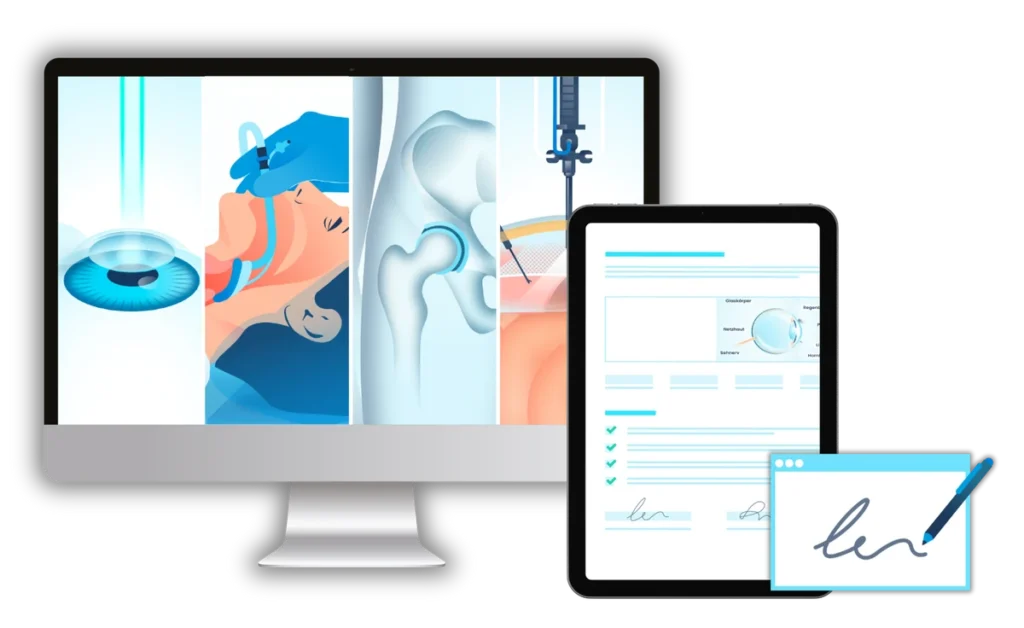
3. fully customizable video reconnaissance
Videos are tailored to the intervention, technology, risks, alternatives and individual characteristics.
Value: Fulfilment of the individualization obligation – a central legal lever.
4. communication in layman’s terms
Complex issues are communicated in a clear, reduced, auditory-visual form.
Value: Comprehensibility in Patient Education = legal effectiveness of consent.
5. documentation and audit trail
Automated, traceable documentation of when the patient has seen which content.
Value: reversal of the burden of proof alleviated – strong forensic protection.
6. relieving the medical teams
Digital advance information creates focus time in the doctor’s consultation for Patient Education.
Value: Doctors concentrate on individual questions – not on standard blocks.
Efficiency and quality levers for everyday clinical practice
Operationally, digital intelligence provides a scalable quality framework:
- 70-80% of standard clarification is carried out digitally in advance (benchmark of our users).
- The actual consultation becomes more patient-specific.
- Documents are standardized, structured and archived in a legally compliant manner.
- Comprehension thresholds drop significantly.
- Patient satisfaction increases because communication becomes more transparent and comprehensible.
This is a real performance booster, especially in clinical settings with limited time budgets.
Conclusion: Comprehensive Patient Education is mandatory today – digital education is the new standard
The combination of increasing legal requirements, growing clinical complexity and forensic expectations makes one thing clear: traditional information is reaching its limits.
Digital, video-based, modular validated solutions such as medudoc set a new best practice standard for:
- Legal certainty
- Documentation quality
- Patient understanding
- Efficiency in everyday clinical practice
- Minimization of forensic risks
Especially in the light of current case law, it becomes clear:
Comprehensive Patient Education is no longer a “nice to have” – it is a strategic compliance and quality lever.