

Würzburg University Hospital: Video-assisted surgical clarification – up to 78% time saving
In a study with 101 patients, the authors Svenja Leicht, Leon Schütze, Johan F. Lock, Christoph-Thomas Germer, Johanna C. Wagner Clinic and Polyclinic for General, Visceral, Transplantation, Vascular and Pediatric Surgery, University Hospital Würzburg the influence of video-assisted surgical information. The results of the study are summarized below.
Video-based surgical clarification as the new gold standard: efficiency, quality, legal certainty
Providing surgical information before a planned operation is one of the most basic medical activities. However, with the increasing availability of digital solutions in healthcare, new possibilities are also emerging in the area of Patient Education – such as video-assisted surgical education. This involves the use of an individually compiled video that supplements the medical consultation. The hopes associated with the use of video-assisted Patient Education range from better patient understanding of the planned procedure, higher patient satisfaction and less anxiety about the procedure to economic aspects such as possible time savings for the medical staff providing the information.
A current prospective cluster-randomized study by the University Hospital of Würzburg now provides hard evidence: The use of individualized explanatory videos – created with medudoc technology – significantly reduces the time required for surgical consultations without compromising patient satisfaction.
For clinics, MVZs and specialists in private practice, this results in scalable transformation potential in one of the most risk-intensive clinical core processes.
Study situation: significant time savings with higher patient satisfaction
The study examined 101 patients prior to elective cholecystectomies and colon interventions. The aim of this study was to compare video-assisted surgical information with conventional information in terms of information time and patient satisfaction. Patients undergoing colonectomies and cholecystectomies were included and divided into a control group and an intervention group. The intervention group received a video developed by the company medudoc Deutschland GmbH for educational support, while the control group was informed according to the previous in-house standard. The results set new benchmarks:
1. massive time reduction in the medical consultation
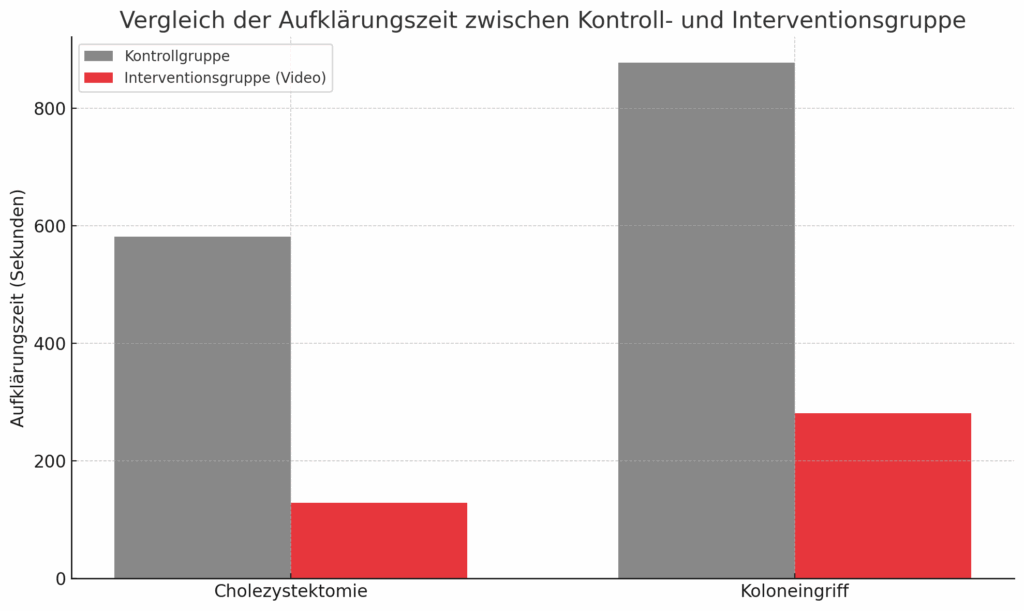
Video-assisted surgical clarification dramatically reduced the net clarification time:
- Cholecystectomy:
581.6 seconds (≈ 9.7 min) → 129.2 seconds (≈ 2.1 min)
Time saving: ~78%, p < 0.001 - Colon interventions:
877.7 seconds (≈ 14.6 min) → 281.1 seconds (≈ 4.7 min)
Time saving: ~68%, p < 0.001
This relieves highly qualified staff where clinical resources are scarcest: in the core medical process.
2. patient satisfaction remains excellent
Despite the shorter duration of medical consultations, the quality level remained stable or increased slightly:
- Very good: 75.5 %
- Good: 24.5 %
No negative impact – on the contrary: the structured communication contributes to greater understanding and less preoperative anxiety.
Why video-assisted education is the future of clinical processes
1. scalable relief with consistently high reconnaissance quality
Video-assisted information creates a new level of efficiency in the clinical workflow. The study clearly shows that the amount of time spent by doctors on information sessions is drastically reduced without compromising the quality of patient information. This frees up valuable capacity for activities that have a direct impact on treatment quality: more intensive care of complex cases, more precise therapeutic planning or closer coordination within the interdisciplinary team. Clinics can thus alleviate operational bottlenecks in the information pathway and at the same time strengthen the basis of a legally compliant informed consent procedure. The result is a highly efficient, scalable process that relieves the burden on medical staff and increases the security of care.
2. individualized explanatory videos as a lever for patient-specific informed consent
A key advantage of video-assisted information lies in its ability to depict highly complex procedures in a visual, structured and layman-friendly way. The videos generated by medudoc are precisely tailored to the respective procedure and can also be configured individually for each patient. It is precisely this aspect that addresses one of the most stringent legal requirements in German-speaking countries: the obligation to provide individualized information. A personalized video significantly increases the patient’s understanding of risks, complications and alternatives – a crucial building block for valid consent. The result is informed consent that is less prone to error, is better understood and leads to greater safety in treatment practice because patients are more realistically prepared and adhere better to post-operative recommendations.
3. process reliability and standardization as the basis for legal and medical robustness
Variability is one of the biggest risk drivers in traditional informed consent discussions. Different ways of presenting information, time pressure and individual conversations can lead to gaps or incomplete information – with a direct impact on legal certainty and treatment quality. Video-assisted informed consent eliminates this variability by creating a standardized quality baseline. Every patient receives all relevant information in a consistent, medically correct depth and structure. There is enough space for the medical team to address individual questions and discuss patient-specific aspects in greater depth. At the same time, the digital documentation ensures that the entire information process remains transparent and traceable – a decisive advantage in audits, QM processes or legal disputes. Hospitals thus safeguard themselves both medically and forensically and noticeably increase process reliability.
4. increasing patient understanding as a driver for better outcomes and higher recovery rates
Video-based education pays off in a dimension that is often underestimated in traditional education research: It improves patients’ receptivity, understanding and self-efficacy. Visual content reduces cognitive load, structures complex information and creates more precise expectation management. Patients who have a better understanding of what to expect have been shown to have less pre-operative anxiety, higher compliance and better adherence in the post-operative phase. This leads to clear clinical benefits: lower complication rates, better recovery rates and higher overall satisfaction with the treatment. Informed consent is therefore not only formally correct – it becomes functionally effective because the patient and treatment team work better together. This is a decisive lever for quality assurance, outcome optimization and sustainable patient satisfaction.