
Smart Medical History: What Sets It Apart from a Digital Questionnaire
Anyone looking for a solution for digital patient registration will quickly come across the term “digital medical history form.” This usually refers to a PDF or a web form that patients fill out on the device of their choice before their appointment—instead of on paper. This is a first step toward digitization, but not a structural one.
After all, a form that merely changes formats does not alter what ultimately appears in the HCP Dashboard: data that is often incomplete, unprioritized, and lacking any indication of clinically relevant findings. Medical staff must then perform the same follow-up work as before—only now digitally.
What actually eases the burden on clinics is something else entirely: a medical history that doesn’t just record information, but also analyzes it.
What makes the difference
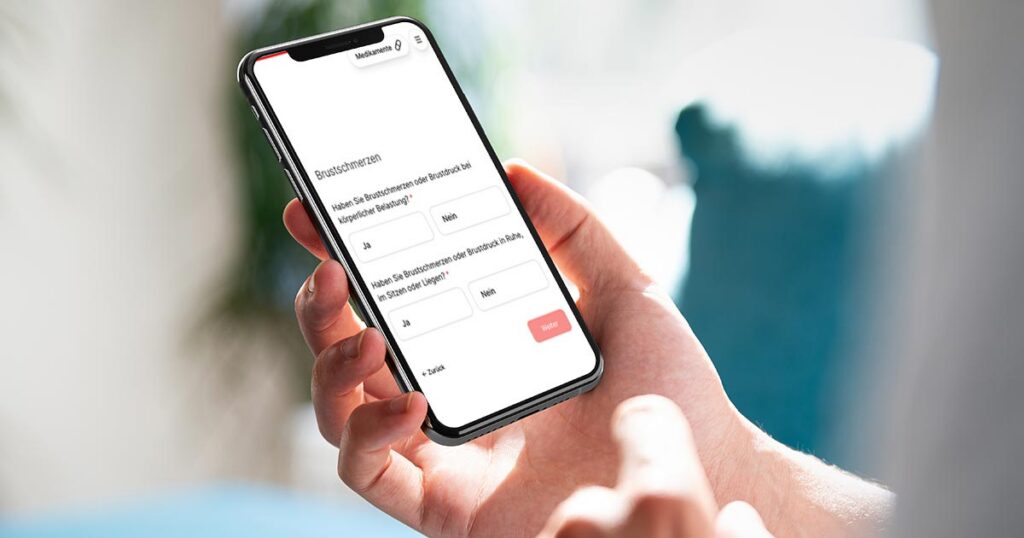
A static questionnaire asks all patients the same questions in the same order. A 28-year-old healthy person scheduled for elective knee surgery and a 67-year-old patient with heart failure, on anticoagulant therapy, and with renal insufficiency scheduled for the same procedure both go through the same form. The result is either too long for the simple case or too short for the complex one.
An adaptive medical history works differently. The questionnaire adapts dynamically: as soon as a person lists pre-existing conditions, medications, or procedure-specific risk factors, targeted follow-up questions appear—not as a fixed block, but based on the situation. A person with no pre-existing conditions can complete it more quickly. A person with a complex profile provides more information because the questions delve precisely into areas that are clinically relevant.
The result for medical staff: more complete data during reviews and fewer follow-up questions during consultations.
What happens after registration
The second difference lies not in the data collection itself, but in what happens to the data afterward.
In a standard form workflow, the responses are submitted as raw data—a list of yes/no answers and free-text fields that medical staff must review and categorize manually. Clinically relevant entries do not stand out from those that are not problematic. Incomplete entries are only noticed when someone looks closely.
What medudoc refers to as “medical reasoning” takes this a step further: the structured medical history data is processed automatically. The platform identifies gaps, flags risk factors, and enriches the data with clinical reference information—before the case appears in the HCP Dashboard. Physicians see processed cases, not raw data.
An important clarification: Medical Reasoning does not make medical decisions and does not replace a medical diagnosis. It presents information in a structured format—exactly as medical staff would like to see it. The medical assessment and approval remain entirely the responsibility of the medical professional.
Specific features that make the difference clear
In addition to the adaptive question set itself, there are several features that make a significant difference in practice:
Medication tracking via barcode. Instead of typing in the drug name, patients scan the barcode or QR code on the medication package. medudoc identifies the drug, records the data in a structured format, and automatically assigns it. This reduces typing errors and incomplete medication lists—one of the most common sources of error in medical history-taking.
Uploading medical reports with data extraction. Patients can upload previous medical records directly. Relevant data is automatically extracted and presented in a structured format for the doctor’s review, eliminating the need for staff to manually search through documents.
Multilingualism without the extra effort. The medical history is available in multiple languages without the need to set up separate processes. This is particularly important for clinics with a high proportion of patients who do not speak German.
SNOMED CT and FHIR. All collected data is standardized using SNOMED CT and transferred to the HIS in FHIR format. This forms the basis for seamless integration into existing system environments—without data discontinuities or the need for manual maintenance.
Why this is especially important in the pre-medication clinic
The premedication clinic is one of the most time-consuming parts of the preoperative admission process. According to a study by Kieninger et al. (Anaesthesist 67, 93–108, 2018), the average waiting time in the pre-anesthesia clinic is 58 minutes. This is often due to the documentation requirements and the need to clarify incomplete or unstructured prior data during the consultation.
For patients in ASA risk classes I and II—who statistically account for the majority of elective procedures—a fully digital medical history form, completed from home prior to the appointment, can significantly reduce the time spent at the clinic. The outpatient capacity freed up as a result is then available for patients whose cases require more intensive medical care.
This is not a theoretical model. However, it assumes that the digital medical history is complete and structured enough to actually serve as the basis for a medical assessment—and not merely as a pre-filled form in digital format.
What a smart medical history is not
It is also worth making this clear. Intelligent anamnesis is not a medical device within the meaning of the EU MDR. It does not make diagnostic decisions and does not replace a physician’s assessment. Products that market medical reasoning or similar concepts as clinical decision support operate in a regulatory gray area that requires careful classification.
Smart medical history-taking is no substitute for a consultation with a doctor. It changes how that consultation begins—namely, with more complete, structured information rather than an empty intake form.
And it is not a one-size-fits-all solution: its full value is realized only when the structured data is processed further within an end-to-end workflow—for medical history, consent forms, or transfer to the hospital information system.
Conclusion
The difference between a digital questionnaire and an intelligent medical history lies not in the interface, but in the process behind it. What matters is whether the data is collected in full, organized in a structured manner, and transferred directly into the clinical workflow—without any manual intermediate steps.
Our workflow overview provides a detailed description of how this workflow is structured as a whole and what requirements it entails for the clinic.