

Why Generic Informed Consent Forms in Hospitals Pose a Liability Risk
Imagine a patient with a known penicillin allergy who, prior to an elective cholecystectomy, receives an informed consent form that, under “Drug Side Effects,” makes a general reference to possible allergic reactions—without any mention of the patient’s specific allergy, without any mention of the planned anesthesia method, and without specific recommendations regarding preoperative measures. The form has been fully completed and signed. But has informed consent truly been obtained?
This issue has been a topic of legal debate for years. And it illustrates why the switch to digital consent forms is not merely a matter of convenience—but one with implications under liability law.
The Legal Framework: What Section 630e of the German Civil Code (BGB) Actually Requires
The German Patient Rights Act (Section 630e of the German Civil Code) is clear on one point: Informed consent must be tailored to the individual patient. It must be based on the patient’s specific circumstances—their diagnosis, risk profile, and state of health—and not on a generic template that is suitable for everyone precisely because it was not tailored to anyone in particular.
Case law has repeatedly clarified this principle. In several rulings, the Federal Court of Justice has emphasized that the duty to inform is not fulfilled merely by handing over a form. What is decisive is proof that patients were actually and fully informed about the risks relevant to them—not about all theoretically possible risks of a procedure.
That sounds abstract. In practice, it means this: A generic informed consent form that provides the same information to a 72-year-old patient with atrial fibrillation, on anticoagulant therapy, and with diabetes as it does to a 35-year-old, otherwise healthy patient—does not offer reliable protection against liability. It documents that information was provided. It does not prove that informed, case-specific consent was obtained.
The Three Sources of Risk in Generic Forms
1. Lack of Relevance: Too Much and Too Little at the Same Time
Generic informed consent forms are optimized for completeness in standard cases. This inevitably means that for patients with relevant comorbidities, an unusual risk profile, or a specific anesthetic procedure, the truly important sections are missing. At the same time, they contain information that is simply irrelevant to these patients.
The counseling session must correct what the questionnaire failed to address. Under time pressure—and in many hospitals, informed consent sessions are limited to six to fifteen minutes—this is only partially successful. Gaps remain. Anything not included in the form and not explicitly discussed is difficult to substantiate in the event of a dispute.
2. Outdated Content: Legal relevance is not a given
Medical guidelines change. Court rulings shift the standard for what must be disclosed. New findings regarding the risks of active ingredients or surgical techniques require adjustments to the content of patient disclosures.
Who in your facility is responsible for ensuring that the informed consent forms currently in use still reflect the latest developments in case law and medical science? This question can rarely be answered satisfactorily in hospitals that use paper-based or static digital forms. The result: forms that have been in use unchanged for years—even though the legal framework has changed.
3. Foreign-language patients: The problem of forms that are not understood
An informed consent form written in a language that patients do not understand does not serve its purpose. The legal requirement is clear: the informed consent must be drafted in such a way that the patient understands it (Section 630e(2)(3) of the German Civil Code (BGB)).
The common practice of providing foreign-language patients with a separate form in their native language only partially solves the problem. Medical staff cannot verify the content of the foreign-language document. There are two versions of the same informed consent document—and in the event of a dispute, the question arises as to which version was actually signed and filed.
Furthermore, separate translations are not necessarily updated at the same time as the German version. An outdated foreign-language version and an updated German version—that is a documentation issue that is difficult to explain during an audit.
What Makes a Truly Personalized Digital Information Sheet Different
The answer to these three sources of risk is not to produce more paper or to update existing forms more frequently. The structural solution lies in automated, case-specific generation.
An Informed Consent Sheet (IC Sheet) based on the medical history data, the type of procedure, and the individual risk profile, contains, by definition, exactly the information relevant to that patient. No more, no less. Comorbidities, medications, allergies, and the planned anesthesia method are incorporated into the content—fully automatically, before the consultation.
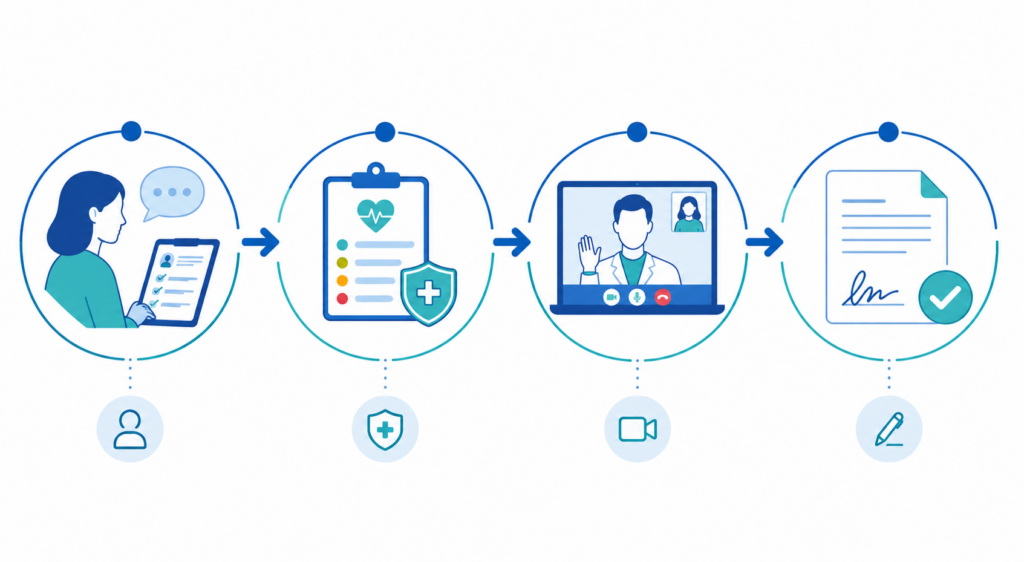
medudoc puts this approach into practice. Here, personalization is not an optional premium feature, but the norm. At the Cantonal Hospital of St. Gallen, the platform was rolled out for standard use following a pilot phase involving 276 patients and was rated as indispensable by 92% of the participating physicians. Depending on the extent of customization, it takes between 14 and 90 seconds to create an IC Sheet.
Regarding legal accuracy: All IC Sheets are automatically analyzed by medudoc on a monthly basis for changes in the legal framework and current case law. In addition, a comprehensive annual medical review of all content is conducted, supplemented by external validation by professors and medical specialists. The responsibility for ensuring that the information is up to date lies with the provider—not with the clinic.
And what about the problem of a foreign language? medudoc solves it with a document concept that is unlike anything else on the market: German and the patient’s foreign language appear side by side in columns—all in a single PDF. The doctor explaining the information can see at any moment what the patient is actually reading. No two documents, no discrepancies in the records, and no questions about traceability.
Efficiency and legal certainty are not mutually exclusive
In discussions about the digitization of Patient Education, efficiency is often presented as a standalone argument—separate from the issue of the quality of Patient Education. This falls short.
A prospective cluster-randomized study at the University Hospital of Würzburg has shown that video-assisted patient education using medudoc reduces the time doctors spend explaining the procedure for cholecystectomies by about 77%—from 9.7 to 2.2 minutes — while maintaining high patient satisfaction (75.5% “very good,” 24.5% “good”). The study was published in December 2024 in Thieme E-Journals (DOI 10.1055/s-0044-1790093).
The results show that a personalized digital informed consent form—provided before the consultation and read by patients at their leisure—does not diminish the depth of the information provided. It simply moves the timing of information absorption forward—and frees up space in the medical consultation for what a form can never replace: personal, attentive care.
What This Means for Your Clinic
The transition from generic to personalized digital informed consent forms is not a technical issue. It is an organizational and legal decision regarding liability.
The most important questions hospital decision-makers should ask themselves in this context are:
Who is currently verifying whether our informed consent forms comply with the latest case law—and when was the last time this was checked? How do we document that informed consent, based on a full understanding, has been obtained from patients who speak a foreign language? And: How transparent is our consent trail when it matters in the event of a dispute?
If there are no clear answers to these questions, the need for action is evident.
For a complete overview of how customized digital informed consent forms work, the available signature levels, and how they are integrated into the overall preoperative process, please visit our page on digital informed consent forms.