

How Much Does Pre-Anesthesia Counseling Really Cost? A Health Economics Analysis.
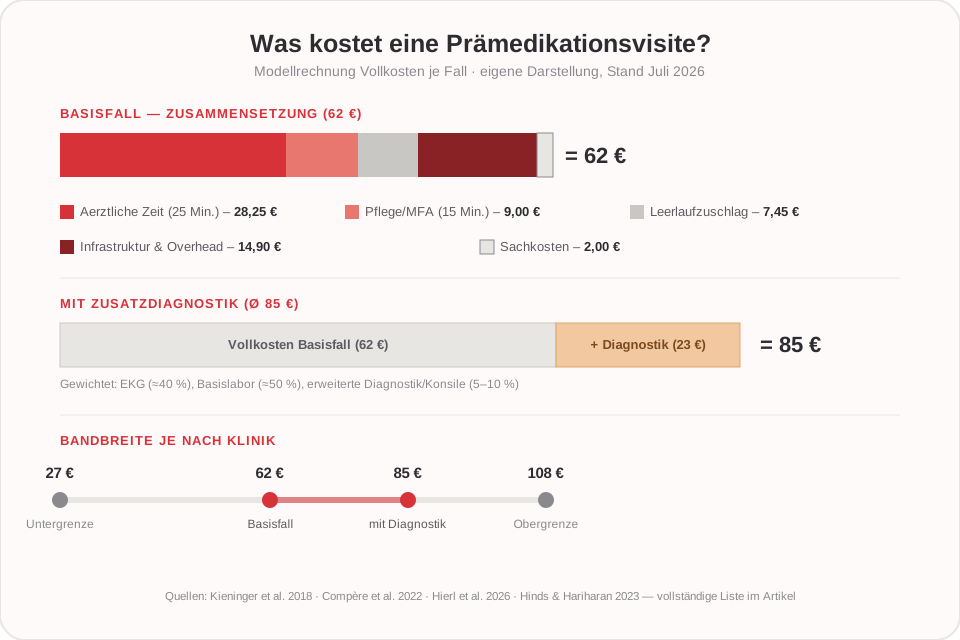
From the hospital’s perspective, a pre-anesthesia consultation costs approximately 60 to 85 € in full costs, ranging from 30 to 140 € depending on the hospital and the case. When patient time is factored in, the total societal costs range from 130 to 180 € per case. To date, there has been no systematic, published calculation of these costs in German-speaking countries—the following model calculation fills this gap based on current literature.
Why is it that hardly anyone knows the cost of a premedication visit?
Premedication—the medical preparation for an elective procedure through medical history, physical examination, patient counseling, and risk assessment—does not generate its own revenue under the reimbursement system. In the DRG system (Diagnosis-Related Groups, the German diagnosis-related group system), it is included in the flat-rate payment; the same principle applies in the Austrian LKF system (Performance-Based Hospital Financing). In the cost matrix of the InEK (Institute for the Hospital Payment System), the premedication visit is grouped under the collective cost center “Anesthesia.” Without a separate revenue item, there is no incentive to calculate it separately—which is why no reliable, up-to-date figure has been available to date.
How long does a pre-anesthesia consultation actually take?
Two recent prospective studies provide reliable time estimates—with a difference of 11 to 34 minutes that seems large at first glance but is easily explained. The difference lies in the definition: Does the measurement include only the bedside consultation, or does it also include the review of test results brought in by the patient?
| Study | Setting | Measured time |
|---|---|---|
| Kieninger et al. 2018, Regensburg University Hospital (prospective study, 2,233 interviews over 38 business days) | Major Utility Provider | Review of records + consultation: 33.6 ± 16.3 min.; average patient wait time: 58.6 ± 30.3 min. |
| Compère et al. 2022, four French hospitals (prospective, n = 1,007) | Mixed | Total consultation time: 11.2 ± 5.8 min. (6.8 min. for information, 4.4 min. for clinical examination) |
The Regensburg group also measures the time spent reviewing the documents brought in—and that is precisely what takes up the most time: The most common disruption to their workflow was missing documents that, according to internal standards, should have already been available. For full-cost accounting, the total time a physician spends on a patient is relevant—including the consultation, review of findings, documentation, and ordering of tests. For the purposes of this analysis, a baseline of 25 minutes is assumed, with a range of 15 to 35 minutes.
How much does a minute of a doctor’s time cost at the anesthesia clinic?
Based on the 2024 collective bargaining rates (TV-Ärzte Unikliniken, TV-L, including the employer’s 25.59% contribution to social security), the cost per minute for a specialist in anesthesiology is approximately €1.13. This current calculation was prepared by Hierl, Schörner, and Alt of Regensburg and reflects only the personnel costs of the occupational groups directly involved—excluding administrative, cleaning, energy, and material costs.
| Occupational Group | Labor costs per minute |
|---|---|
| Board-Certified Anesthesiologist | €1.13 |
| Specialized Nursing in Anesthesia | 0.73 € |
| Senior Physician (Surgical) | €1.39 |
| Surgical Resident | 0.92 € |
An additional rate of approximately €0.50 per minute can be applied for registration and assistance in an outpatient clinic. According to the Federal Statistical Office, personnel costs accounted for just under 62% of total hospital costs in 2021—the remaining portion is attributed to infrastructure, material costs, and overhead.
What is the total cost of a pre-medication visit?
In the base case, the total cost amounts to approximately €62 without additional diagnostics, ranging from €27 (lean process) to €108 (full-service provider with high overhead). The following table shows the composition.
What is premedication?
Premedication is the preparatory medical procedure performed prior to an elective procedure, particularly in connection with anesthesia. It includes taking a medical history, conducting a physical examination, providing patient education, assessing risk, and, if necessary, administering medication. In many hospitals, the premedication clinic is a separate workflow area within the preoperative process.
| Position | Assumption | Amount |
|---|---|---|
| Medical Journal | 25 min. × €1.13/min. | 28.25 € |
| Nursing/Medical Assistant (Registration, Vital Signs, Preparing Medical Records, Scheduling Appointments) | 15 min. × €0.60/min. | 9.00 € |
| Direct Labor Costs | 37.25 € | |
| Idle/Standby Surcharge (utilization rate approx. 80%, no-shows, gaps in the schedule) | +20 % | 7.45 € |
| Infrastructure & Overhead (Space, Energy, Cleaning, HIS/IT, Administration, Depreciation) | +40% in direct labor costs | €14.90 |
| Direct material costs (informed consent form license, printing, anesthesia certificate) | 2.00 € | |
| Total without additional diagnostics | ≈ 62 € |
| Scenario | Constellation | Result |
|---|---|---|
| Lower limit | 15 min. resident physician (≈ €0.95/min.), 8 min. medical assistant, streamlined process, 10% idle time, 30% overhead | ≈ 27 € |
| Base Case | See the table above | ≈ 62 € |
| Upper limit | 35 min. specialist/senior physician (€1.25/min.), 20 min. nursing care, 30% idle time, 50% overhead, primary care provider | ≈ 108 € |
How much do the additional diagnostic tests before the procedure cost?
If we realistically factor in ECG (for about 40% of patients), basic laboratory tests (about 50%), and advanced diagnostics or consultations (5–10%)—the total cost, including diagnostics, comes to about 85 euros (range: 45–140 euros). This is precisely where the greatest potential for control lies: Not every patient needs an ECG or lab tests.
Hinds and Hariharan conducted a prospective study of 636 elective patients and, based on the guidelines of NICE (National Institute for Health and Care Excellence, the British health authority), classified 64% of all preoperative tests as not indicated; these non-indicated tests accounted for 59% of total diagnostic spending.
Does this estimate hold up to external scrutiny?
Yes—four independent data points support the order of magnitude and suggest that the base-case estimate is on the conservative side.
- Direct point of comparison: Lee and colleagues report an outpatient cost rate of the equivalent of approximately 109 U.S. dollars per patient for an anesthesiology outpatient clinic in Hong Kong—a figure that, after conversion and taking into account the years that have passed since then, is remarkably close to the estimate presented here.
- Update on the German figure: In 2004, Bauer and colleagues estimated the cost of the pre-medication visit at €13.00 for 20 minutes of physician time. At today’s per-minute rate of €1.13, this amounts to €22.60—and when nursing care, idle time, and overhead are factored in, the total falls within the same range as in the base case.
- Cost structure related to the outpatient clinic: In the study by Lee et al., although preoperative costs were lower in the outpatient group, total perioperative costs did not differ significantly—because postoperative bed costs accounted for about three-quarters of the total costs. Premedication itself represents a minor cost item.
- Patient Perspective: In Toulouse, Ferre and colleagues compared teleconsultations with in-person visits among 401 orthopedic patients: the average cost savings were €122 per patient, with a time commitment of 22 minutes instead of 130 minutes, and no significant difference in postoperative complication rates.
What costs do patients have to pay themselves?
With an average wait time of nearly an hour, plus travel time to and from the hospital, two to three hours per visit is a realistic estimate—at a rate of 25 to 35 € per hour plus travel expenses, this amounts to 50 to 120 € per case, a cost that is systematically excluded from hospital cost calculations.
When combined with the full cost of hospitalization, this results in total societal costs of roughly 130 to 180 € per preoperative consultation. A German preference study by Aust and colleagues shows that patients do indeed value this time: Out of a hypothetical budget of 100 €, 36 € were allocated to having the premedication visit conducted by the same person who administers the anesthesia, and 26 € to waiting less than two hours.
Which four strategies are most effective at reducing the cost of premedication?
In descending order of impact: indication-based approach to supplementary diagnostics, complete medical records at the initial visit, appointment scheduling and capacity utilization, and low-risk telemedicine.
- Indications for supplementary diagnostic testing. By far the largest single cost category is also the one that is easiest to avoid—see the 64% figure cited by Hinds and Hariharan above.
- Complete documentation will be provided at the time of presentation. The Regensburg data identify missing findings as the main source of disruption in the process—every minute spent searching costs about €1.13.
- Schedule Management and Capacity Utilization. The idle-time surcharge is not an accounting gimmick, but rather actual holding costs. A more even distribution of patient volume throughout the day directly lowers unit costs.
- Low-risk telemedicine. From the hospital’s perspective, the savings are moderate; from a societal perspective—as shown by the data from Toulouse—they are significant.
All four levers essentially address issues of digitization in the preoperative workflow: They concern how complete the medical history data is prior to the appointment, how structured the scheduling process is, and for which patient groups an in-person appointment is actually necessary. medudoc’s digital preoperative workflow maps out precisely these steps—from the medical history to risk assessment to patient education—in a seamless process. Via an FHIR interface, medical history data and prior findings are available in a structured format even before the appointment, which directly counteracts the cause of time loss described under Lever 2. For patients in risk classes ASA I and ASA II (American Society of Anesthesiologists classification, Grades I–II: healthy individuals or those with only mild systemic conditions), who account for the majority of elective procedures, the informed consent process can also be conducted from home according to hospital-specific configurations—the telemedicine approach described under Lever 4. The decision regarding necessary additional diagnostics and any medical assessment remains entirely with the physician; medudoc structures and provides information for this assessment but does not replace it.
A randomized study conducted by the University Hospital of Würzburg demonstrates how highly structured processes and personalized, video-assisted Patient Education can reduce the time required for Patient Education. The article “Preoperative Admission Process: Where Doctors Lose Time” describes exactly where time is currently being wasted in the admission process.
What are the limitations of this calculation?
This estimate is a model-based calculation, not a survey—there are three important limitations to keep in mind when interpreting it.
- The 40% overhead surcharge is the most uncertain assumption. It can only be derived on a building-by-building basis from cost center accounting; a methodologically sound approach would be a time-driven activity-based costing analysis using measured capacity cost rates.
- The personnel cost rates are from a German university hospital and, according to the authors, are expressly not intended to be universally applicable. Premiums for on-call, night, and weekend work are not included.
- The same logic applies to Austria, although the absolute tariff values differ. Since services are not scored separately in the LKF system either, calculations must also be performed internally using cost center accounting.
Note on the Data Basis: The calculation presented in this article is a proprietary model based on the values cited in the literature, as of July 2026. It is not a substitute for facility-specific cost center accounting. The assumptions regarding overhead, utilization, and the diagnostic component are clearly stated and should be adjusted for each specific location.
Frequently Asked Questions About the Cost of Premedication
Sources
- Bauer M, Schleppers A, Raetzell M, Hanß R, Mertens E, Scholz J. Outpatient Surgery: Calculation of Anesthesiology Costs and Revenues. Anesth Intensivmed 2004;45:293–299. PDF
- Kieninger M, Eissnert C, Seitz M, Judemann K, Seyfried T, Graf B, Sinner B. Analysis and Options for Optimizing Premedication Consultations at a University Hospital. Anaesthesist 2018;67:93–108. DOI: 10.1007/s00101-017-0392-3
- Compère V, Froemer B, Clavier T, Selim J, Burey J, Dureuil B, Gillibert A, Besnier E. Evaluation of the Duration of the Preanesthesia Consultation: A Prospective, Multicenter Study. Anesth Analg 2022;134(3):496–504. DOI: 10.1213/ANE.0000000000005889
- Hierl K, Schörner L, Alt V. What is the cost per minute of surgery and per day in the intensive care and general wards? Unfallchirurgie 2026;129:111–122 (Open Access). DOI: 10.1007/s00113-025-01644-0
- Hinds, S., & Hariharan, S. An Economic Evaluation of Preoperative Investigations for Elective Surgical Patients at a Caribbean Tertiary Care Teaching Hospital. Cureus 2023;15(1):e33528. DOI: 10.7759/cureus.33528
- Lee A, Chui PT, Chiu CH, Gin T, Ho AMH. The cost-effectiveness of an outpatient anesthesia consultation clinic prior to surgery. Perioper Med (Lond) 2012;1:3. DOI: 10.1186/2047-0525-1-3
- Ferre F, Furelau P, Labaste F, Costa N, Vardon F, Piau A, Martin C, Minville V. Medical-Economic and Ecological Impact of Anesthesia Teleconsultation. JMIR Form Res 2025;9:e70259. DOI: 10.2196/70259
- Aust H, Eberhart LHJ, Kalmus G, Zoremba M, Rüsch D. The Relevance of Five Key Aspects of the Premedication Round. Anaesthesist 2010;59:414–420. DOI: 10.1007/s00101-010-1828-1
- InEK / GKV-Spitzenverband et al.: Calculation of Treatment Costs – Handbook for Use in Hospitals, Version 4.0, October 2016. Methodology Handbook
Are you planning to implement a structured digital transformation of your hospital’s premedication clinic?
Schedule a consultation with medudoc, or start by getting an overview of all the medical specialties that medudoc already covers.