The information sheet is not a form, but the result of a process
With medudoc, a digital informed consent form is not created by selecting a suitable template from a library, but is generated automatically from upstream data: medical history, type of procedure, and individual risk profile are combined to produce a patient-specific Informed Consent Sheet (IC Sheet). The form is thus the end product of a data flow—not the starting point of a form-filling process.
What is the difference between a form and a data flow end product?
A form is filled out by a person. A data flow output is automatically generated from existing structured data—the patient reads and signs the completed document instead of filling it out themselves.
Traditional informed consent forms, whether on paper or as PDFs, are templates: one form per type of procedure, which the treating professional fills in with patient-specific information. The digital informed consent form on medudoc works the other way around. Medical history, procedure details, and risk profile are already available in a structured format before the form is even created—the IC Sheet is generated from this data, not filled out manually.
| Characteristic | Traditional Information Sheet | IC Sheet as the Final Data Flow Product |
|---|---|---|
| Starting point | Blank or partially filled-out form | Existing medical history and procedure data |
| Customization | Manually, through a doctor’s note | Automated based on risk profile and procedure data |
| Multilingualism | Separate documents for each language | One document: original German version plus translation |
| Update | Some sheets need to be replaced | Content is managed centrally within the medical editorial network |
| Proof of Consent | Signature on paper or PDF | Consent Trail with reading time, follow-up questions, and timestamps |
What data is included in an individual IC sheet?
An IC Sheet incorporates data from at least four sources: the patient’s medical history, the planned type of procedure, the calculated risk profile, and the patient’s language preference.
- Medical history —previous medical conditions, medications, allergies, relevant prior procedures
- Procedure and Treatment Data – Planned Surgery or Examination, Selected Anesthesia Method
- Risk Profile – Automatically Pre-Assessed Using Medical Reasoning
- Language settings – up to 23 languages; see below
- Previous informed consent —for repeat procedures, provided it is documented
The Pillar Page “Intelligent Medical History vs. Digital Questionnaire” describes how this medical history data is structured and recorded. At medudoc, the term “Medical Reasoning” refers to the automated, rule-based analysis of structured medical history data to conduct a preliminary assessment of completeness and risk factors. This preliminary assessment does not replace a medical diagnosis or decision—the final medical assessment always remains the responsibility of the physician; Medical Reasoning merely prepares the data for this assessment.
How does this automatically generate a customized IC sheet?
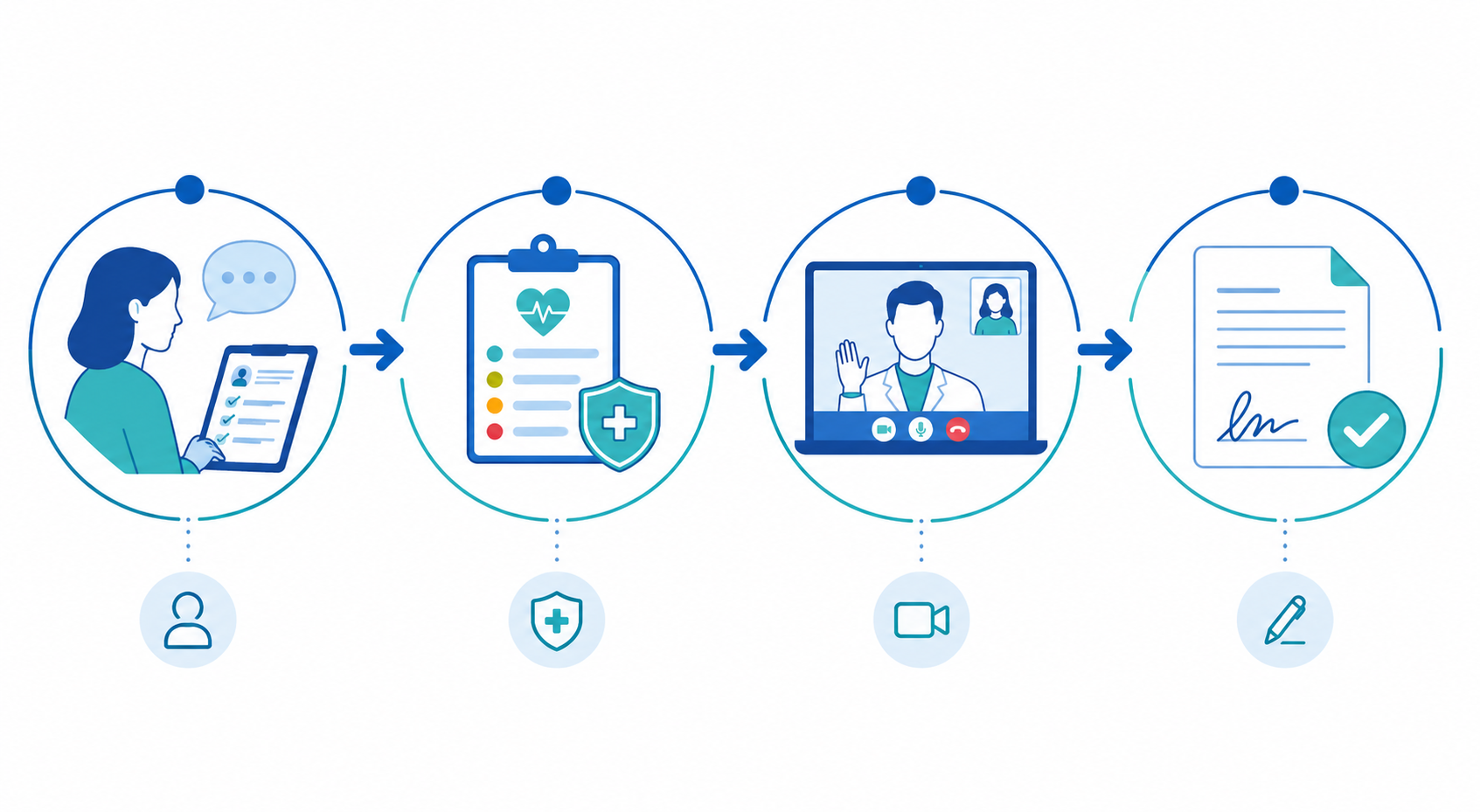
The form is generated in five steps, without the patient having to fill in any information manually.
- Recording the medical history —in a structured manner using the clinic’s digital medical history form
- Calculate Risk Profile – Medical Reasoning Analyzes the Medical History Data
- Assign Content – Relevant educational content from medudoc’s medical editorial network
- Generate videos and IC sheets —tailored to each patient—in 14 to 90 seconds per case, according to an internal evaluation of the St. Gallen Cantonal Hospital case study
- Prepare for signing —electronically, as a simple, advanced, or qualified electronic signature, depending on the requirements
The following explanatory video from medudoc shows what this kind of automatically generated, personalized content looks like in practice:
Digital Patient Education with medudoc – Official Explanatory Video (medudoc, YouTube).
Why isn’t a template library enough for this?
A library of standard forms remains static with respect to each individual form. A data flow responds dynamically to each specific case because it does not select from pre-created documents but rather reassembles content anew for each case.
Many solutions available on the market offer extensive libraries with hundreds to thousands of standard forms to choose from. This is a legitimate and proven approach—but it shifts the burden of customization to the person making the selection, who must choose the most appropriate form from the available templates and, if necessary, add handwritten notes. With a data-flow approach, this selection step is eliminated: The combination of medical history, type of procedure, and risk profile automatically determines which content—and in what form—is included in the document. This is particularly evident in the context of multilingualism: Instead of maintaining pre-produced forms for each language, medudoc combines the original German version and a foreign language into a single document generated specifically for each case.
What does the data flow mean for the traceability of the explanation?
Because the IC Sheet is generated from a documented data flow, it is possible to provide complete documentation not only of the signature but also of the entire reconnaissance process.
At medudoc, this comprehensive documentation is referred to as a “consent trail”—it records which content was viewed and when, which sections were reopened, and which questions were asked, in addition to the signature’s timestamp. This represents a qualitative difference from a simple signature on a form, because in the event of a dispute, it not only proves that informed consent was provided, but also to what extent. The page “Informed Consent in Medicine” summarizes the fundamentals of informed consent; the technical and organizational framework for handling this data is documented in medudoc’s security guidelines.
Is the medical consultation still necessary?
Yes. An automatically generated IC sheet prepares for and documents the informed consent discussion—it does not replace the verbal, in-person explanation provided by the healthcare professional.
According to Section 630e of the German Civil Code (BGB), the physician’s explanation must be provided orally and in a manner that the patient can understand; a written format is not required, but is advisable for documentation purposes. A customized IC Sheet allows patients to review the information in advance, leaving more time during the consultation itself for questions and personalized, case-specific explanations. The page “Legal Basis for Patient Education” summarizes the complete legal framework for Patient Education in Germany, Austria, and Switzerland (DACH).
Frequently Asked Questions
For a complete overview of personalized digital informed consent forms, available signature levels, and their integration into the overall preoperative process, please visit the page on digital informed consent forms.
The article “Why Generic Informed Consent Forms Pose a Liability Risk” describes the specific liability risks associated with generic forms. The article “From Medical History to Informed Consent: More Time for High-Risk Patients” shows how a well-structured medical history can free up additional time for high-risk patients.
Additional Resources
- § 630e BGB – Duty to Inform: gesetze-im-internet.de
- Regulation (EU) No. 910/2014 (eIDAS) – Electronic Signatures in the EU: EUR-Lex
- Study by the University Hospital of Würzburg on video-assisted surgical counseling: Thieme E-Journals, DOI 10.1055/s-0044-1790093