


In many facilities in the DACH region, digital patient education has long ceased to be a topic for the future; it is a strategic necessity. Rising documentation requirements, increasing specialisation, economic pressure and changes in how patients seek information are exacerbating the structural weaknesses of conventional patient education processes. At the same time, legal and ethical responsibility remains as high as ever: valid consent requires that patients actually understand the nature, scope, risks, alternatives and consequences of a measure.
A gap opens up between legal requirements, organisational reality and everyday clinical practice. Digital patient education promises efficiency, standardisation and legal certainty. Yet its implementation is not an IT project. It is a far-reaching intervention in medical, legal and organisational processes. This guide shows what matters strategically – for hospitals as well as for office-based physicians.
1. The structural problem of conventional patient education processes
In practice, patient education is often carried out under time pressure, ad hoc and depending on individual communication styles. Paper-based forms are supplemented, annotated by hand, signed and archived. In complex care settings – such as anaesthesia, orthopaedics or interventional cardiology – content varies depending on the surgeon, the resident or the clinic day.
The weaknesses of this system are structural:
- Inconsistent content: even for identical procedures, wording, risk presentation and emphasis differ considerably.
- Documentation risk: illegible additions, missing dates or incompletely completed forms can be problematic in the event of a dispute.
- Inefficiency: repeated oral explanations of standardised procedures tie up physician resources without a proportional gain in understanding.
- Cognitive overload: patients often receive complex information in an emotionally stressful situation – shortly before a procedure or within a tight practice schedule.
Digital patient education addresses these weaknesses – provided it is not mistaken for the mere digitalisation of paper forms.
2. Digital patient education is not a PDF on a tablet
A common misconception is to equate digital with electronic signature. However, a scanned form on a tablet does nothing to change the quality of the content or the cognitive structure of patient education.
Digital patient education only delivers its added value when it:
- conveys medical content in a structured, visually supported and comprehensible way,
- provides standardised, quality-assured content,
- takes individual risk constellations into account in a differentiated way,
- is integrated into existing systems with secure documentation,
- and complements the physician’s dialogue rather than replacing it.
What matters is the didactic and process architecture. Video-based sequences can explain complex matters – such as surgical procedures, anaesthetic techniques or typical complications – consistently and comprehensibly. But generic videos quickly reach their limits: an elective arthroscopic procedure in an athletic 25-year-old woman differs structurally from a complex revision in multimorbid patients.
This is where a central differentiating factor of modern systems becomes apparent: modular individualisation.
3. Modular individualisation instead of one size fits all
Many digital solutions work with standardised complete videos for each procedure. Although these are uniform, they are often too general or too long. The result: unnecessary information load or a lack of specificity.
A modular system, by contrast, allows video sequences to be compiled individually on the basis of defined criteria:
- type and variant of procedure
- anaesthetic technique
- risk profile (e.g. anticoagulation, pre-existing conditions)
- age group or special patient groups
- organisational specifics (e.g. outpatient vs. inpatient)
The structural advantages of this modular individualisation are considerable:
- Cognitive efficiency: patients receive only the content relevant to them – neither too much nor too little.
- Legal robustness: the documentation reflects exactly which content was conveyed.
- Role and specialty specificity: different specialist departments can use specific modules without producing redundant content.
- Scalability: new procedures or guideline changes can be adapted at module level without having to produce complete content from scratch.
Particularly in the DACH context, where the requirements for informed consent are high and courts regularly examine whether risks were explained in a sufficiently individualised way, this differentiation is not a technical detail but a strategic advantage.
4. Regulatory framework: what to consider during implementation
Digital patient education sits at the intersection of professional law, civil law, data protection and organisational responsibility. Even though a comprehensive legal assessment in individual cases remains the preserve of specialised lawyers, some basic principles can be identified.
In Germany, for example, the physician’s duty to inform is based on Section 630e of the German Civil Code (BGB). What matters is personal, timely and comprehensible information about the essential circumstances of the procedure. Digital elements can support this duty, but cannot substitute for it. The physician’s discussion remains indispensable.
For implementation, this means:
- Digital content must be embedded in a face-to-face discussion as a preparatory and structuring element.
- It must be provided sufficiently in advance of the procedure to give patients time to reflect.
- The documentation must show traceably which content was conveyed and when.
- Data protection requirements (GDPR) must be taken into account, particularly with cloud-based solutions.
Hospitals are advised to coordinate closely with data protection officers, the legal department and quality management. Office-based practices should at least carry out a structured risk analysis, particularly when using external platforms.
5. Organisational implementation: from pilot project to routine
Technically, digital patient education systems can usually be introduced faster than they can be culturally embedded. Resistance arises less from rejection of digital technology than from uncertainty about changing roles.
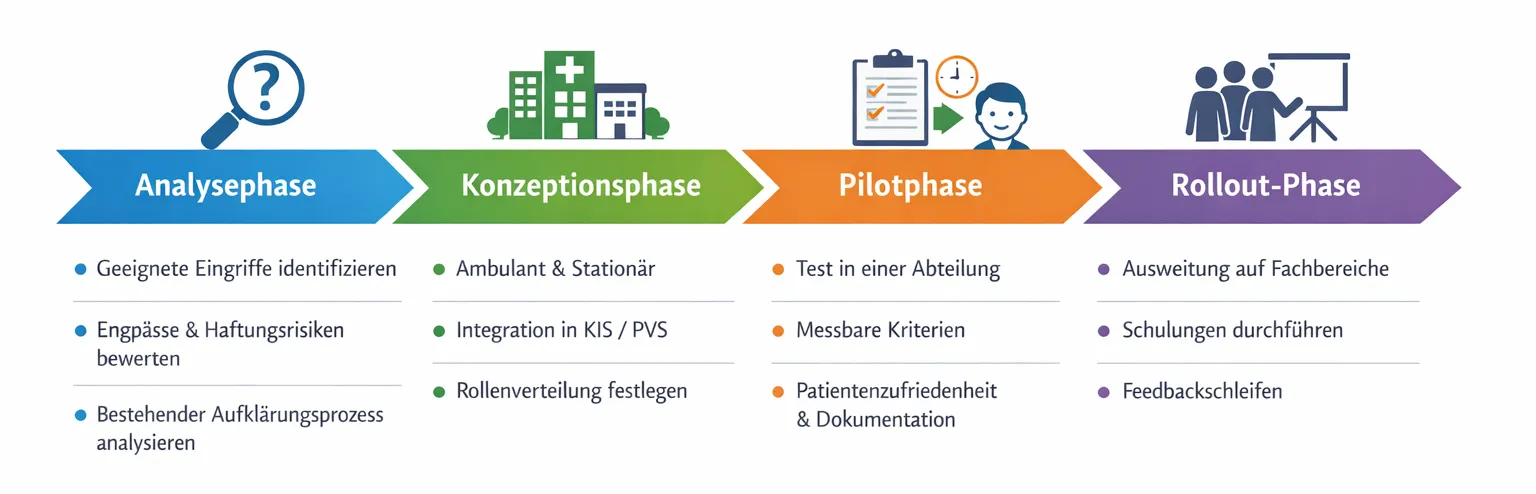
A structured implementation process typically comprises the following phases:
- Analysis phase:
Which procedures are suitable for initial implementation? Where are there current bottlenecks or liability risks? How is the existing patient education process organised? - Design phase:
Definition of the target architecture: outpatient/inpatient, integration into pre-admission care, integration into the HIS/PMS, division of roles between physicians and nursing staff. - Pilot phase:
Start in a clearly defined department with measurable parameters: duration of the consent discussion, patient satisfaction, completeness of documentation. - Rollout phase:
Gradual extension to further specialties, accompanied by training and feedback loops.
It is crucial not to communicate digital patient education as a relief instrument for individual people, but as a structural quality measure. It professionalises processes – and at the same time makes them more transparent.
6. The psychological dimension: control, trust and acceptance
Patient education is not only a legal obligation, but also a central act of trust. Digital formats can strengthen this trust – or undermine it.
Patients often appreciate being able to watch content in a calm environment, with the option of repeating sequences. Visual representations of complex procedures increase understanding. At the same time, there must be no impression that the face-to-face discussion is being “replaced by a video”.
Physicians also have implicit concerns: loss of individual latitude, standardisation of communication or additional technical hurdles.
A clear position helps here: digital patient education structures the information space. The physician’s discussion remains the place for individual risk-benefit assessment, for putting information into context and for answering personal questions. Standardisation does not mean taking away autonomy; it means consistency of quality.
7. Practical example: pre-admission patient education in orthopaedics
An orthopaedic hospital with a high volume of knee arthroscopies faced the problem that consent discussions often took place on the day before surgery. Time pressure, repeated standard explanations and incomplete documentation led to dissatisfaction on both sides.
With the introduction of modular digital patient education, patients were given individualised video sequences several days before the procedure – differentiated by type of procedure, anaesthetic technique and specific risk factors.
The content of the physician’s discussion shifted: less basic information, more focus on individual questions and particular circumstances. At the same time, it was possible to document which modules had been watched and when the face-to-face discussion took place.
The structural change lay not primarily in the technology, but in spreading the process out over time and in the clear division of roles between standardised information and individual medical counselling.
8. Strategic perspective: digital patient education as a building block of process quality
Digital patient education should not be considered in isolation. It is part of a broader digital pre-admission strategy: appointment management, taking the medical history, document management and process control are interlinked.
Its strategic value lies in three dimensions:
- Quality: standardised, modular content increases consistency and traceability.
- Efficiency: physician time is focused more on individual decision-making aspects.
- Legal protection: transparent documentation strengthens the position in the event of a liability claim, without replacing individual review in each case.
Particularly in complex organisations with several sites, changing staff and different specialist disciplines, modular, individualised digital patient education creates a common content base – without losing the necessary differentiation.
Conclusion: from digitalisation to structural redesign
Implementing digital patient education is not a technical upgrade but a structural redesign of medical communication processes. Reducing it to the electronic signature wastes its potential. Understanding it as a strategic instrument for standardisation, individualisation and legal robustness, on the other hand, creates a new level of quality in the pre-admission workflow.
In an increasingly specialised, liability-sensitive and resource-constrained healthcare landscape in the DACH region, digital patient education is thus becoming a decisive building block of professional organisational development. Not as a replacement for medical responsibility – but as its systematic, scalable and differentiated support.
