


Imagine a patient with a known penicillin allergy who, before an elective cholecystectomy, receives a consent sheet that makes a blanket reference to possible allergic reactions under “Side effects of medication” — without reference to their specific allergy, without mention of the planned anaesthetic procedure, without a specific recommendation on preoperative measures. The sheet is formally complete and signed. But did informed consent really take place?
This question has occupied the courts for years. And it shows why switching to digital informed consent sheets is not a matter of convenience — but a decision with relevance under liability law.
The legal framework: what § 630e BGB actually requires
The German Patients’ Rights Act (Section 630e of the German Civil Code, BGB) is clear on one point: patient information must be individual to the patient. It must be based on the patient’s specific circumstances — their diagnosis, risk profile and state of health — and not on a generic template that suits everyone because it was tailored to no one.
The courts have repeatedly clarified this principle. In several decisions, the Federal Court of Justice (BGH) has stressed that the duty to inform is not fulfilled by merely handing over a form. What matters is proof that patients were actually and fully informed about the risks relevant to them — not about every theoretically possible risk of a procedure.
That sounds abstract. In practice, it means that a generic consent sheet that gives a 72-year-old patient with atrial fibrillation, anticoagulation and diabetes the same information as a 35-year-old, otherwise healthy patient offers no reliable protection against liability. It documents patient information. It does not prove that informed, case-specific consent took place.
The three sources of risk in generic sheets
1. Lack of relevance: too much and too little at the same time
Generic consent sheets are optimised for completeness in the standard case. This inevitably means that, for patients with relevant comorbidities, an unusual risk profile or a specific anaesthetic procedure, the really important passages are missing. At the same time, they contain information that is simply irrelevant to that patient.
The consent discussion has to correct what the sheet missed. Under time pressure, this only partly succeeds — in a study at University Hospital Würzburg, conventional physician consent before cholecystectomy took a median of 8.1 minutes. The gaps remain. Whatever is not in the sheet and was not explicitly discussed is difficult to prove in a dispute.
2. Outdated content: legal currency does not take care of itself
Medical guidelines change. Court decisions shift the standard of what must be disclosed. New findings on the risks of active substances or on surgical techniques require changes to patient education content.
Who in your facility is responsible for ensuring that the consent sheets in use still reflect the current state of case law and medical science? In hospitals with paper-based or static digital sheets, this question can rarely be answered satisfactorily. The result: sheets that have been in use unchanged for years — although the legal framework has changed.
3. Patients who speak other languages: the problem of the sheet that is not understood
A consent sheet in a language the patient does not speak does not fulfil its purpose. Legally, this is clear: patient information must be designed so that the patient understands it (§ 630e(2) no. 3 BGB).
The common practice of giving patients who speak other languages a separate sheet in their first language only partly solves the problem. Medical staff cannot check the content of the foreign-language document. Two versions of the same patient education content exist — and in a dispute the question arises as to which version was actually signed and stored in the files.
In addition, separate translations are not necessarily updated in sync with the German version. An outdated foreign-language version alongside an updated German version is a documentation problem that is difficult to explain in an audit.
What a truly individual digital informed consent sheet does differently
The answer to these three sources of risk is not to produce more paper or to update existing sheets more often. The structural solution lies in automated, case-specific generation.
An Informed Consent Sheet (IC Sheet) generated on the basis of the medical history data, the type of procedure and the individual risk profile contains, by definition, exactly the information relevant to that patient. No more, no less. Comorbidities, medication, allergies and the planned anaesthetic procedure feed into the content — fully automatically, before the discussion.
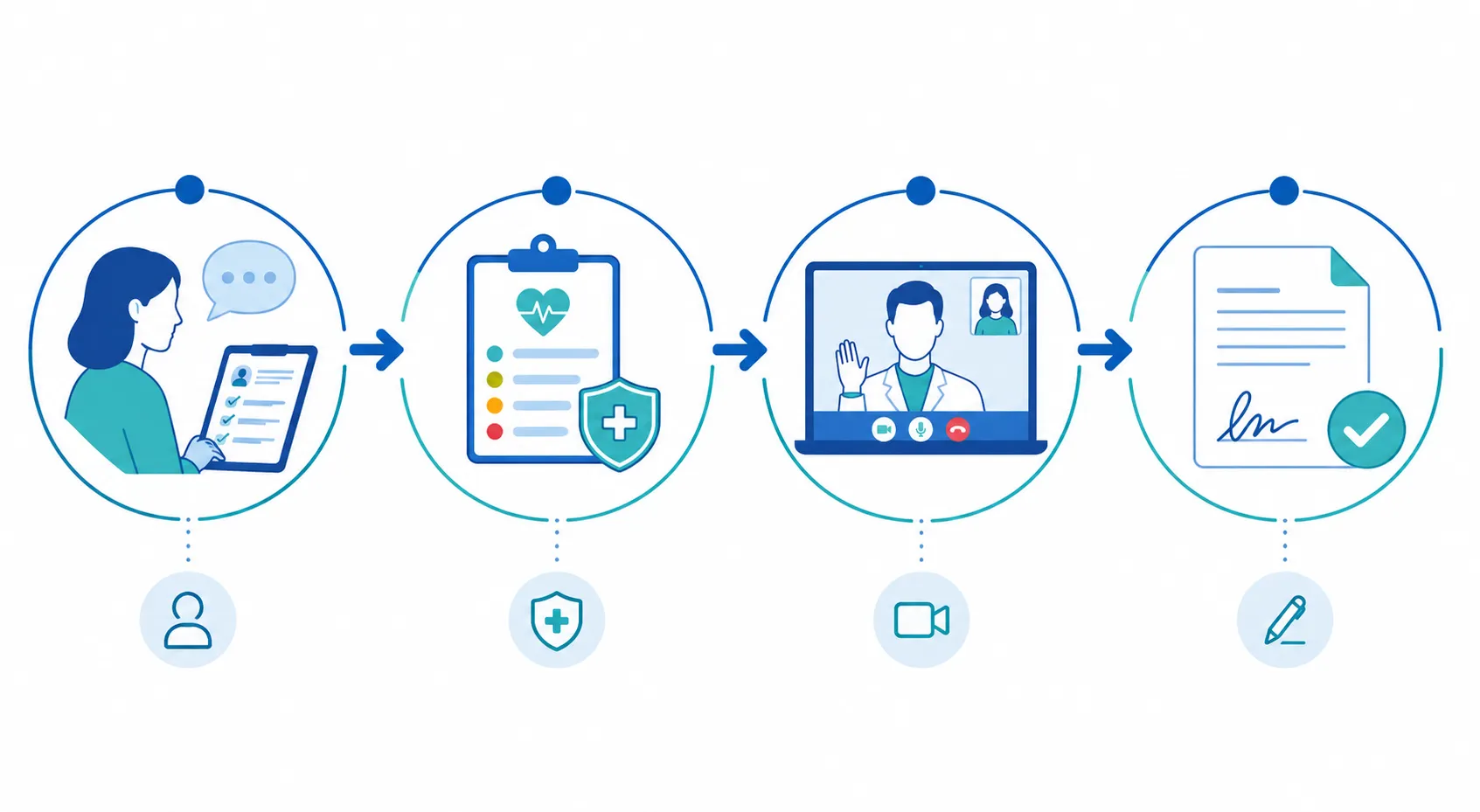
medudoc puts this approach into practice. Individualisation is not an optional premium feature but the standard case. At Cantonal Hospital St. Gallen, the platform moved into standard use after a pilot phase with 276 patients and was rated as indispensable by 92% of the physicians involved. Depending on the degree of individualisation, creating an IC Sheet takes between 14 and 90 seconds.
As regards legal currency: at medudoc, all IC Sheets are analysed automatically every month for changes in the legal framework and current case law. In addition, every piece of content undergoes a full medical review once a year, supplemented by external validation by professors and specialists. Responsibility for keeping content up to date lies with the provider — not with the hospital.
And the language problem? medudoc solves it with a document concept that has not existed on the market until now: German and the patient’s language appear side by side in columns — in a single PDF. The physician providing the information can see at any moment what the patient is actually reading. No two documents, no discrepancy in the files, no open question about traceability.
Efficiency and legal certainty are not opposites
In discussions about digitalising patient education, efficiency is often presented as a separate argument — detached from the question of the quality of patient information. That falls short.
A prospective study at University Hospital Würzburg showed that video-assisted patient education with medudoc reduces the median physician discussion time before cholecystectomy by 81% — from 8.1 to 1.5 minutes. Patient understanding and satisfaction remained high. The study was published in 2026 in the World Journal of Surgery (DOI 10.1002/wjs.70561).
The result shows: an individualised digital informed consent sheet, provided before the discussion and read by patients at their own pace, does not reduce the depth of the patient information. It moves the uptake of information forward in time — and gives the consent discussion room for what a sheet can never replace: personal, attentive support.
What this means for your hospital
Switching from generic to individualised digital informed consent sheets is not a technical question. It is an organisational decision and one with consequences under liability law.
The key questions hospital decision-makers should ask themselves:
Who checks today whether our consent sheets reflect the current state of case law — and when were they last checked? How do we document that patients who speak other languages gave informed consent they understood? And: how traceable is our consent trail when it matters in a dispute?
If these questions have no clear answer, the need for action is tangible.
A complete overview of how individualised digital informed consent sheets work, the available signature levels and their integration into the overall preoperative process can be found on our page on digital informed consent sheets.
