


In both Austrian and German law, patient education is non-negotiable. It is a core component of every treatment contract (Austria: ABGB, KAKuG, ÄrzteG and the Patients’ Charter under Art. 15a B-VG; Germany: Sections 630a–630e of the German Civil Code, BGB). Operationally, this means that without valid, complete, individual and legally sound patient information, physicians face a considerable liability risk – with clear impact on liability insurance, documentation, litigation risk and the reputation of the facility.
Current court decisions show clearly that requirements are rising, and so are the courts’ expectations. At the same time, traditional consent processes are often under pressure in clinical reality – lack of time, language barriers, heterogeneous patient groups, varying documentation quality.
This is exactly where digital solutions such as medudoc come in: they professionalise the consent process, create consistent quality standards and significantly reduce the risk of forensic gaps.
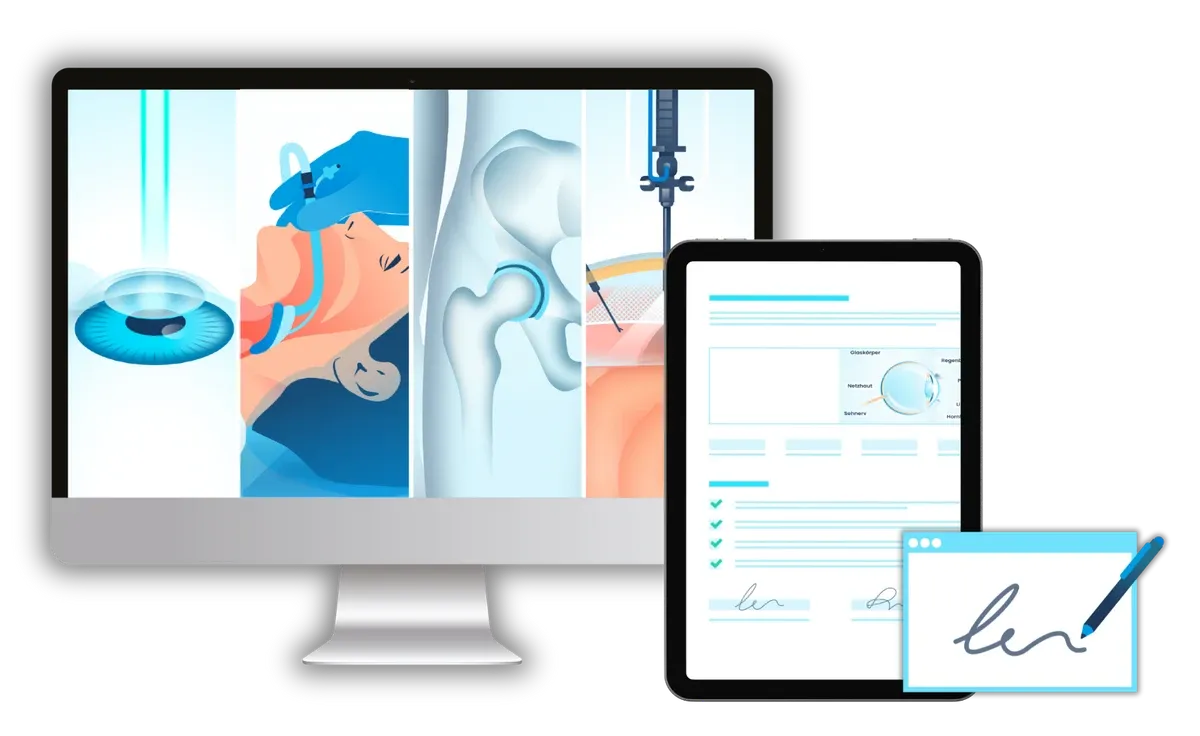
Why comprehensive patient information is mandatory today
Courts have long since stopped examining only whether patients were informed – they examine how thoroughly, how individually and how well documented. The “standard of care” has clearly shifted towards complete communication of risks and alternatives. Our research analysis identifies the following drivers:
- Duty to individualise
Patient information must be patient-specific – state of health, age, pre-existing conditions, particular risks, psychological strain. Standard forms without individual reference are increasingly considered insufficient. - Transparency about rare risks
Rare complications must also be explained if they are serious or may be relevant to the individual patient. - Information about alternatives
The patient must be able to make a genuine choice between treatment options – including conservative alternatives. - Comprehensibility as a compliance factor
The information must be understandable to laypeople – a recurring problem in proceedings over deficient patient information.
Digital patient education as a standard for quality and risk management
Research shows that patients take in information better when it is multimedia, modular, in plain language and can be consumed at their own pace. medudoc puts exactly these principles into practice.
How medudoc transforms the quality of patient education and legal certainty
1. Modular, guideline-based content
All content is built along current guidelines of the medical societies.
Value: comprehensive forensic coverage; consistent quality of content.
2. Validated by clinical experts
Independent specialists review every sequence.
Value: clinical precision, fewer blind spots for risks.
3. Fully customisable video-based patient education
Videos are tailored to the procedure, technique, risks, alternatives and individual circumstances.
Value: fulfilment of the duty to individualise – a key legal lever.
4. Communication laypeople can understand
Complex matters are conveyed in a clear, reduced, audiovisual form.
Value: comprehensibility in patient education = legal validity of consent.
5. Documentation and audit trail
Automated, traceable documentation of when the patient viewed which content.
Value: makes it easier to prove the consent discussion, for which the treating party bears the burden of proof (Section 630h(2) BGB).
6. Relief for medical teams
Digital information in advance creates focused time in the consent discussion with the physician.
Value: physicians concentrate on individual questions – not on standard blocks.
Levers for efficiency and quality in everyday clinical practice
From an operational perspective, digital patient education provides a scalable quality framework:
- 70–80% of standard patient information is delivered digitally in advance (internal medudoc analysis).
- The actual consent discussion becomes more patient-specific.
- Documents are standardised, structured and archived in a legally sound way.
- Patients come to the discussion with more prior knowledge.
- Patient satisfaction rises because communication becomes more transparent and easier to follow.
Especially in clinical settings with limited time budgets, this is a real boost to performance.
Conclusion: comprehensive patient education is mandatory today – digital patient education is the new standard
The combination of rising legal requirements, growing clinical complexity and forensic expectations makes one thing clear: traditional patient education is reaching its limits.
Digital, video-based, modularly validated solutions such as medudoc set a new best-practice standard for:
- legal certainty
- documentation quality
- patient understanding
- efficiency in everyday clinical practice
- minimising forensic risks
In the light of current case law in particular, it becomes clear:
Comprehensive patient education is no longer a “nice to have” – it is a strategic lever for compliance and quality.
