


Surgical patient education before a planned operation is one of the most fundamental medical tasks. It is legally mandatory, medically necessary and at the same time one of the largest time items in the preoperative admission process. In many hospitals, this process still takes place much as it did twenty years ago: handwritten forms, standard content conveyed orally, documentation after the discussion.
The real question is not whether this process can be digitalised. It is more specific: where exactly does the effort arise — and what can be changed structurally there without lowering the quality of patient education?
Three points at which effort systematically arises
A typical preoperative admission process is divided into three stages: preparing patients before the appointment, the medical history and patient education phase in the hospital, and documentation and handover to the HIS. In paper-based processes, each of these phases produces structural inefficiencies — not because of individual errors, but because of the system.
Before the appointment, patients often receive their documents only when they arrive at the hospital. Medical history forms are filled in by hand, often incompletely. Missing information on pre-existing conditions, medication or allergies has to be collected again in the discussion — effort that would not arise if documentation were complete in advance.
In the consent discussion itself, basic information on standard procedures is conveyed orally, recurring every day, regardless of what a person has already understood and what not. The discussion starts from a standardised starting point instead of where there is still an individual need for clarification.
After the discussion, further effort arises from media discontinuities: handwritten or form-based consent documents are scanned and kept in parallel with the electronic patient record. Handover to the HIS is manual or does not happen at all.
What the data show
A prospective, cluster quasi-randomised study at University Hospital Würzburg put a concrete figure on the savings potential in the consent discussion alone. The study compares video-assisted surgical informed consent with conventional patient education in terms of time required and patient satisfaction. The full publication appeared in the World Journal of Surgery in 2026 (Leicht SGPD, Schuetze L, Lock JF, Germer CT, Wagner JC. “Video-Assisted Versus Conventional Surgical Informed Consent in Visceral Surgery – A Cluster Quasi-Randomized Clinical Trial.” World J Surg 2026; 50(10): 2866. DOI: 10.1002/wjs.70561).
153 patients scheduled for elective cholecystectomy or colon resection were enrolled: 84 received video-assisted patient education, 69 received conventional patient education according to the hospital standard.
The result: before cholecystectomy, the physician’s discussion with video took a median of 1.5 minutes — compared with 8.1 minutes conventionally. This corresponds to a reduction of 81% (p < 0.0001). Before colon resection, discussion time fell from 11.9 to 3.3 minutes, a reduction of 72% (p < 0.0001).
What makes these figures particularly relevant: patient understanding and satisfaction were high in both groups — regardless of whether patients were informed with video assistance or conventionally.
The study thus provides structural evidence for what many physician colleagues intuitively suspect: the time required for the discussion falls measurably when patients arrive well prepared. The substantive value of the patient education does not suffer.
What changes when the entire process is planned digitally
Video-based patient education on its own changes the overall effort only to a limited extent if the medical history is still taken on paper and the consent document is scanned afterwards. The structural lever lies in linking the individual process steps.
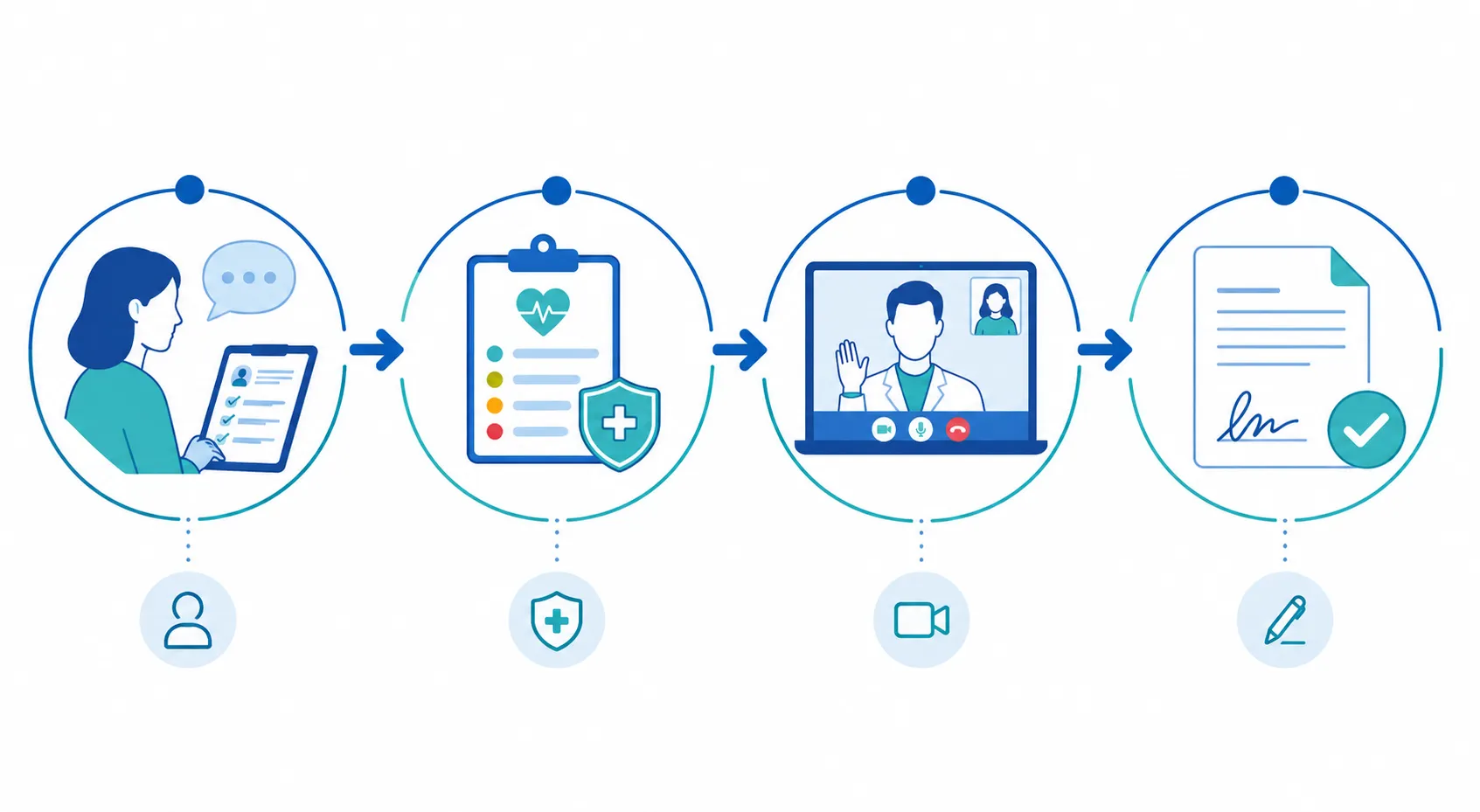
Conceptually, a digitally planned preoperative admission process looks like this: patients receive the invitation to the digital medical history in good time before the appointment, on any internet-enabled device. The medical history is adaptive — follow-up questions are asked automatically when pre-existing conditions, medication or other information affect the risk profile. Based on the data collected, the patient education video is compiled for the individual patient. Consent is given electronically and archived in an audit-proof manner. Medical history results and consent status are returned to the HIS.
At the end of this process, the person arrives at the discussion already prepared. Medical staff can pick up where there is a genuine need for clarification — not where the standard information begins.
Experience at Cantonal Hospital St. Gallen, one of the largest hospitals in Switzerland, shows that this approach works in clinical practice. After a pilot phase with video-assisted patient education, more than 92% of the participating physicians stated that they would not want to do without it in future. The platform was moved into standard use.
What matters when choosing a solution
Hospitals that want to change the preoperative admission process structurally should look at a few specific criteria when selecting a solution.
Is the medical history adaptive? A static questionnaire captures all patients in the same way — regardless of whether they have an uncomplicated risk profile or a complex clinical picture. Adaptive logic asks only the questions that are relevant based on previous answers. This shortens completion time for patients and improves data quality for the staff conducting the patient education.
Is the patient education really personalised? Generic patient education videos show all patients the same content, regardless of pre-existing conditions, medication and the specific type of procedure. Personalised patient education takes the individual profile into account — further reducing the need for clarification in the discussion.
Is the consent trail complete? Electronic consent must be archived in an audit-proof manner and be retrievable in the context of the HIS record. Media discontinuities between the digital platform and paper-based archives carry particular risk at this point — both for documentation quality and in the event of a liability claim.
How deep is the HIS integration? Solutions that do not receive master data from the HIS and do not write medical history results back create duplicate data maintenance instead of relief. The question of which interfaces are supported and how the data flow is regulated in practice should be asked early in the evaluation phase.
Conclusion
The preoperative admission process is one of the central levers for time efficiency, documentation quality and liability protection in everyday hospital practice. The available evidence shows that structural time savings are achievable — without compromising the quality of patient education or patient satisfaction.
The way there does not lead through isolated digitalisation measures at individual points, but through a consistently linked process: from the adaptive medical history through personalised video-assisted patient education to legally sound electronic consent and HIS handover.
You can read how such an end-to-end workflow is structured and what it requires in the hospital in our summary of the preoperative workflow.
