


Anyone looking for a solution for digital patient intake quickly comes across the term “digital medical history form”. This usually means a PDF or a web form that patients fill in on the device of their choice before the appointment — instead of on paper. That is a first step towards digitalisation, but not a structural one – and not yet a smart medical history.
A form that only changes the medium does not change what ultimately arrives in the Healthcare Professional Dashboard (HCP Dashboard): often incomplete data, without prioritisation, without any indication of clinically relevant abnormalities. Medical staff then have to do the same follow-up work as before — only now digitally.
What genuinely relieves hospitals is a different category: a medical history that does not just capture information but thinks along.
What makes the difference
A static questionnaire asks all patients the same questions in the same order. A healthy 28-year-old before elective knee surgery and a 67-year-old patient with heart failure, anticoagulation and renal insufficiency before the same procedure go through the same form. The result is either too long for the simple case or too short for the complex one.
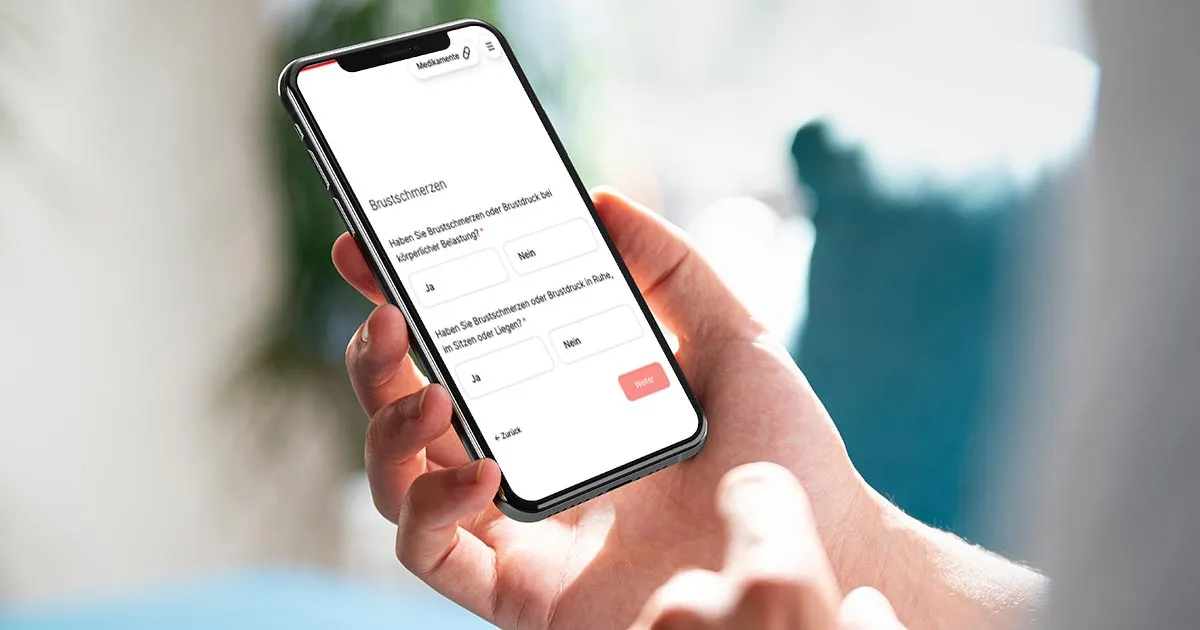
An adaptive medical history works differently. The questionnaire adapts dynamically: as soon as a person reports pre-existing conditions, medication or procedure-specific risk factors, targeted follow-up questions appear — not as a fixed block, but depending on the situation. A person without pre-existing conditions gets through faster. A person with a complex profile provides more information, because the questions follow up exactly where it is clinically relevant.
The result for medical staff: more complete data at review, fewer follow-up questions in the discussion.
What happens after data capture
The second difference lies not in data capture itself, but in what happens to the data afterwards.
In a standard form workflow, the answers arrive as raw data — a list of yes/no answers and free-text fields that medical staff have to review and classify manually. Clinically relevant entries do not stand out from unproblematic ones. Incomplete information is only noticed when someone looks closely.
What medudoc calls Medical Reasoning goes one step further: the medical history data captured in structured form are processed further automatically. The platform identifies gaps, flags risk factors and enriches the data with clinical reference information — before the case appears in the HCP Dashboard. Physicians see prepared cases, not raw data.
An important clarification: Medical Reasoning does not make medical decisions and does not replace a medical diagnosis. It prepares information in structured form — the way medical staff want to see it anyway. Medical assessment and clearance remain entirely with the physician.
Specific functions that make the difference visible
In addition to the adaptive question sequence itself, a number of functions make a considerable difference in practice:
Medication capture by barcode. Instead of typing in product names, patients scan the barcode or QR code on the medication pack. medudoc recognises the product, captures the data in structured form and assigns it automatically. This reduces typing errors and incomplete medication lists — one of the most common sources of error in the medical history.
Upload of prior findings with data extraction. Patients can upload prior findings directly. Relevant values are read out automatically and are available in structured form for the physician’s assessment, without staff having to search through documents manually.
Multilingual without extra effort. The medical history is available in several languages, without separate processes having to be set up. This is particularly relevant for hospitals with a high proportion of patients who do not communicate in German.
SNOMED CT and FHIR. All data collected are normalised in structured form according to SNOMED CT and transferred to the HIS via FHIR. This is the basis for clean integration into existing system landscapes — without media discontinuities or manual rework.
Why this matters particularly in the pre-anaesthesia clinic
The pre-anaesthesia clinic is one of the most time-intensive areas of the preoperative admission process. According to a survey by Kieninger et al. (Anaesthesist 67, 93–108, 2018), the mean waiting time in the pre-anaesthesia clinic is 58 minutes. The reason often lies in the documentation workload and the need to re-collect incomplete or unstructured prior data in the discussion.
For patients in ASA physical status classes I and II — who statistically account for the majority of elective procedures — a fully digital medical history completed at home before the appointment can considerably shorten the time on site. The clinic capacity freed up in this way is then available for patients whose cases require more intensive medical care.
This is not a theoretical model. However, it requires the digital medical history to be complete and structured enough to actually serve as a basis for the physician’s assessment — and not just as a pre-filled paper form in digital guise.
What a smart medical history is not
It is worth stating this clearly as well. A smart medical history is not a medical device within the meaning of the EU MDR. It does not make diagnostic decisions and does not replace the physician’s judgement. Offerings that market Medical Reasoning or similar concepts as clinical decision support operate in a sensitive regulatory area that requires careful classification.
Nor is a smart medical history a substitute for the discussion with the physician. It changes what this discussion starts with — namely more complete, structured information instead of an empty intake form.
And it is not a universal solution: its added value only fully materialises when the structured data are processed further in a continuous workflow — for patient education, for the consent document, for HIS handover.
Conclusion
The difference between a digital questionnaire and a smart medical history lies not in the interface, but in the process behind it. What counts is whether the data are collected completely, prepared in structured form and passed directly into the clinical workflow — without manual intermediate steps.
Our workflow overview describes in detail how this workflow is structured as a whole and what it requires in the hospital.
