


The surgery date is set and the premedication consultation is scheduled. Only at the appointment does a patient mention that he increasingly needs help in everyday life. Another patient has an abnormal haemoglobin value whose cause has not yet been clarified. Both situations raise the same organisational question: when could further clarification have started?

Illustrative image, AI-generated: consultation on preoperative preparation.
Two current guidelines give reason to review the preoperative workflow. The German S3 guideline on the perioperative care of patients with frailty dates from August 2025. The updated S3 guideline on preoperative anaemia dates from February 2026. The German Society of Anaesthesiology and Intensive Care Medicine (DGAI) reported on both publications in 2026. The guidelines address different risks. Together, they offer a starting point for developing early preparation in the pre-anaesthesia clinic further. Sources (in German): DGAI on the frailty guideline, DGAI on the anaemia guideline.
Frailty before surgery: understanding resilience and need for support
Frailty describes an increased vulnerability to stressors. Age alone does not adequately reflect this condition. Indications can include unintentional weight loss, increasing weakness, limited mobility and reduced physical capacity. The need for support in everyday life also provides important information. AWMF: patient guideline on frailty
The clinical guideline recommends frailty screening as early as possible – for elective procedures, as soon as the indication for surgery is made. This timing recommendation is based on expert consensus. Assessing frailty early makes it possible to take frailty status into account in further care and, where needed, to plan additional clarification or preparatory measures. AWMF: frailty guideline, section 4.3
For the pre-anaesthesia clinic, it therefore matters whether this information is available before the consultation and who follows it up. Frailty screening follows a defined clinical procedure. Information from the medical history serves as preparation; its clinical interpretation remains the task of the treatment team.
Preoperative anaemia: an abnormal finding needs a follow-up process
The updated anaemia guideline describes preoperative anaemia as an independent risk factor and as an important part of Patient Blood Management. The focus is on diagnosis and on treatment that addresses the underlying cause. AWMF: S3 guideline on preoperative anaemia
A low haemoglobin (Hb) value does not yet answer the question of cause. Iron deficiency is one possible explanation; chronic disease, impaired kidney function or other deficiencies are also possible. The DGAI emphasises timely diagnosis of the cause and targeted therapy. It does not recommend undifferentiated iron therapy without evidence of iron deficiency. DGAI: classification of the updated anaemia guideline
For the hospital workflow, this results in a practical task: a relevant finding must reach a responsible person and trigger a clear next step. Who reviews the results? Who initiates further clarification? And who tracks whether it is completed before the procedure?
What information does the pre-anaesthesia clinic need early on?
The following areas of information are a suitable starting point for preparation agreed within the hospital. The overview serves as organisational guidance; the treatment team defines examinations and screening procedures.
| Area of information | Examples for preparation |
|---|---|
| Everyday life and resilience | Mobility, independence, changes in the need for support |
| Nutrition and weight trend | Information on unintentional weight loss and existing nutritional problems |
| Pre-existing conditions and medication | Current conditions, medication list, known anaemia and previous treatment |
| Existing findings | Relevant physician’s letters and laboratory results, including date |
| Open clarifications | Missing documents, pending examinations, agreed follow-up appointments |
A complete collection alone is not enough from an organisational perspective. For every open task, a responsible unit and a processing time should be defined. This keeps it clear which information has already been assessed and where action is still needed.
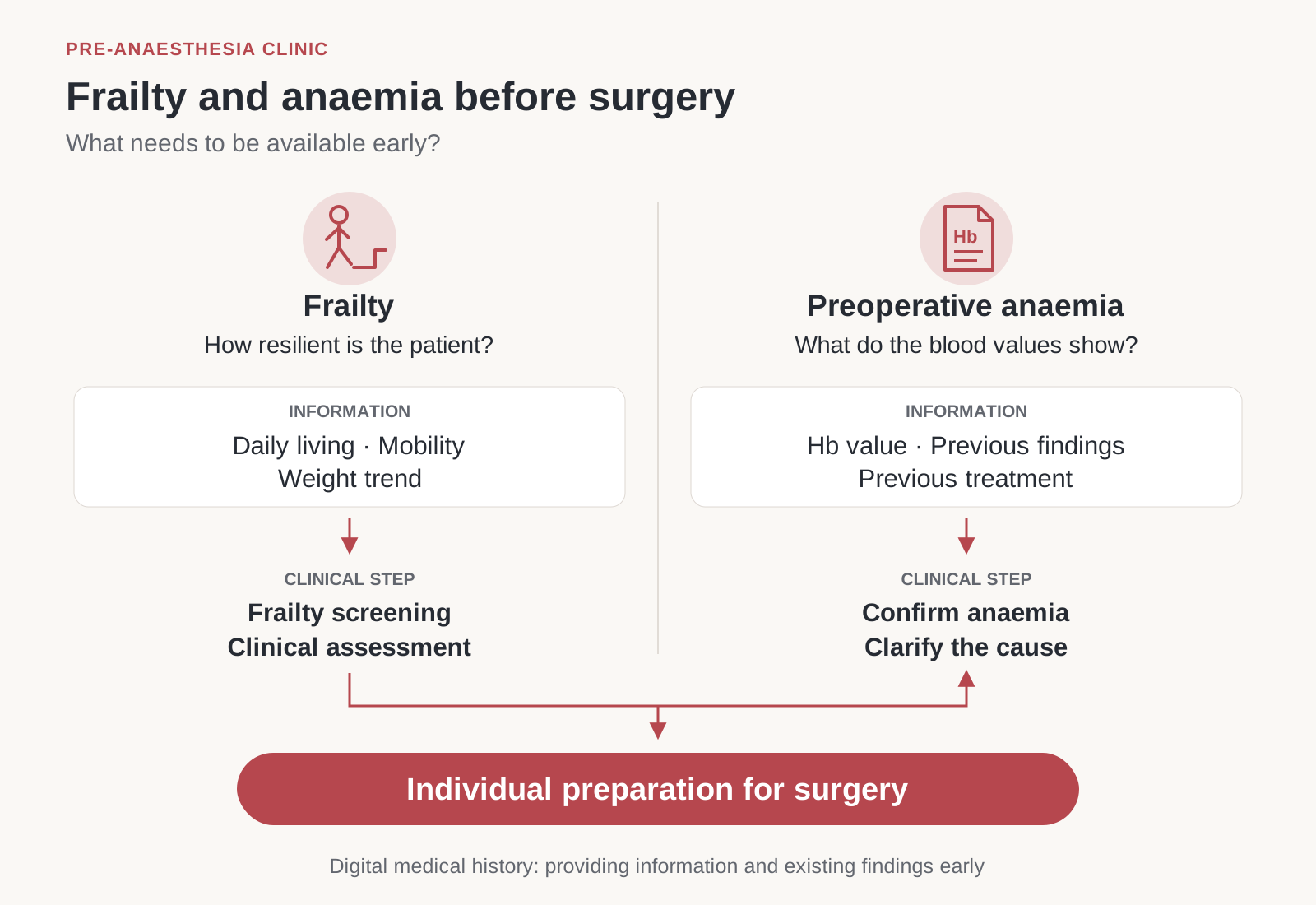
Frailty and preoperative anaemia require different information and clinical clarification. Both paths lead to individual preparation for surgery. Editorial overview, not a diagnostic algorithm.
Recording frailty and Hb values with medudoc for the physician’s assessment
medudoc offers functions for frailty assessment and for recording haemoglobin values in preoperative preparation. Physicians find both in the Healthcare Professional Dashboard (HCP Dashboard), in the step validation and risk assessment. medudoc records relevant information and findings in a structured way and flags abnormal information directly. Physicians see at a glance which information matters for their assessment and where further clarification is needed.
For frailty assessment, the physician documents their classification according to the Clinical Frailty Scale (CFS) in medudoc and adds a clinical assessment. The interface combines the CFS selection with a visible risk notice and a free-text field. This keeps the classification and the physician’s assessment traceable together.
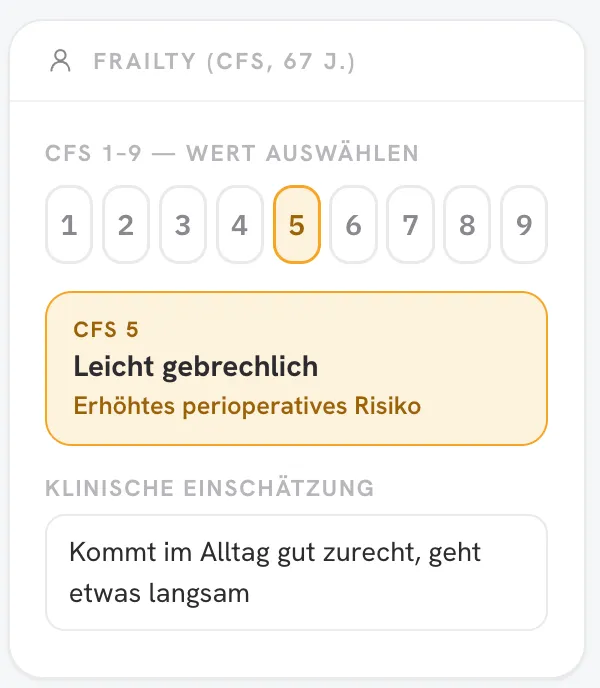
CFS selection and documented clinical assessment (German user interface).
medudoc also records Hb values for the preoperative assessment. Flagged abnormalities make a targeted review of the data easier. Whether anaemia is present and which cause is possible is assessed by the treating physician. The same applies to further examinations or measures: they are based on the findings and the individual situation.
The coagulation view also shows how medudoc makes abnormalities visible: medudoc clearly highlights a notice about active anticoagulation.
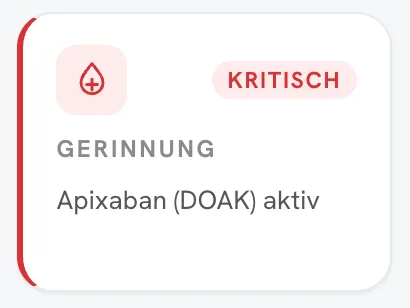
Example of a highlighted coagulation notice (German user interface).
The view for regional anaesthesia shows the physician’s documentation: physicians select their own assessment and add individual comments and conditions.
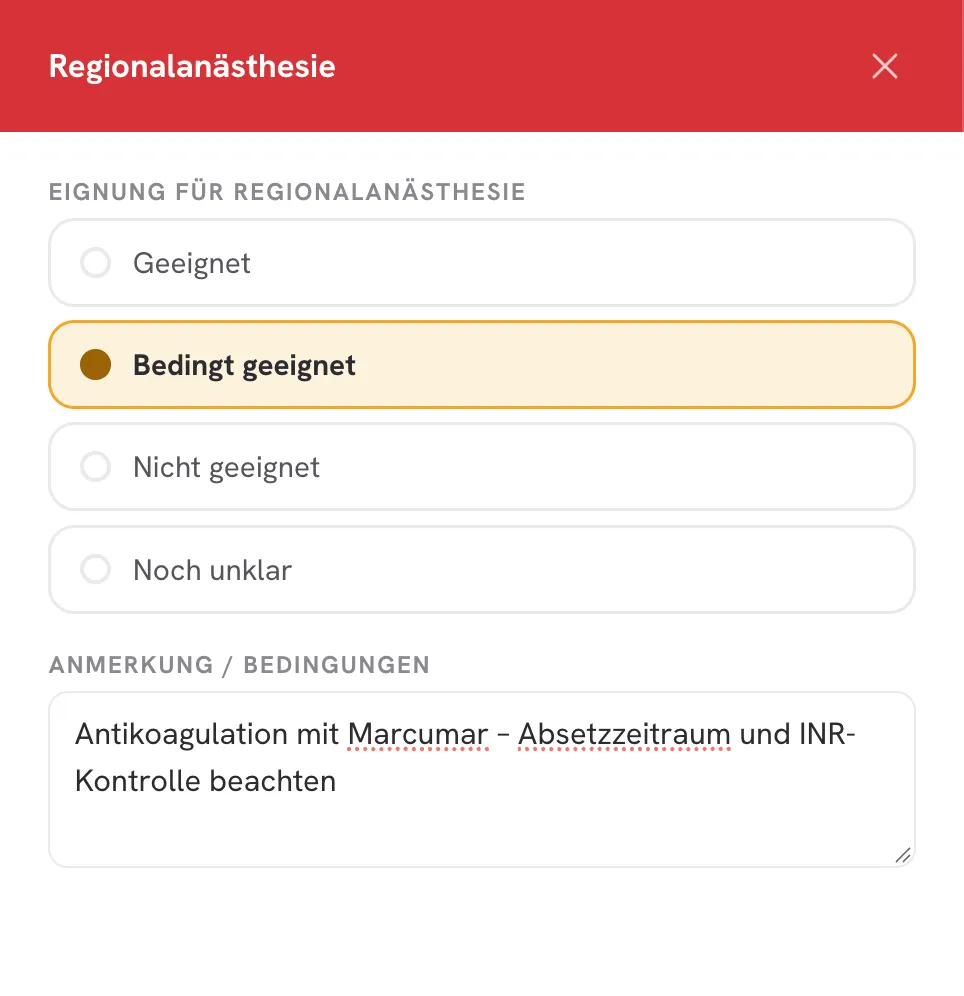
Own classification and physician’s comments on regional anaesthesia (German user interface).
medudoc flags. You decide. Flags and structured input serve for orientation and documentation. The clinical interpretation, the risk assessment and the decision on how to proceed are made by the physician. medudoc is not a medical device within the meaning of the EU Medical Device Regulation (MDR). The platform collects, organises and visualises the information; physicians carry out the medical classification. The views shown illustrate the functions; the visible entries are examples.
Three questions for reviewing your own workflow
The guidelines are a good occasion to review the existing process together with anaesthesia, the surgical departments and the teams involved:
- When does preparation begin? Check which information only becomes available at the appointment in the pre-anaesthesia clinic and which you can already collect earlier.
- Who takes the next step? Define who assesses abnormal information, requests missing findings and coordinates further clarification.
- How is the processing status made visible? Make it traceable which tasks have been completed and which results are still missing before a decision.
Also consider patients who need support with completing digital forms. An assisted on-site process and clearly reachable contact persons therefore belong in the planning.
Would you like relevant information and findings to be available before the premedication consultation? Find out how medudoc supports anaesthesiology from digital medical history to premedication.
